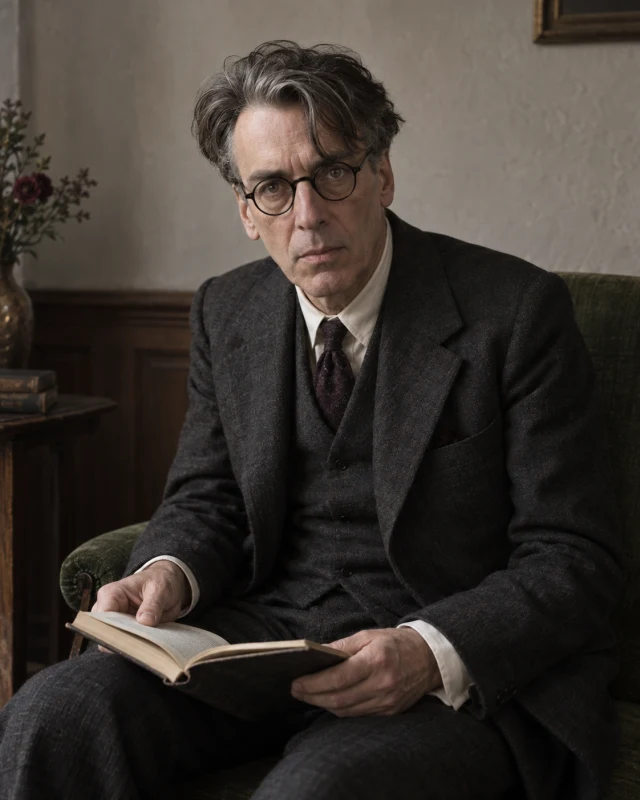
Responsibilities, and Other Poems — Studio AI narration
“In dreams begins responsibility.”
About this work
Responsibilities, and Other Poems marks the great turning point of Yeats's career. First gathered by his sister's Cuala Press in 1914 and issued by Macmillan in 1916, the collection opens with the famous epigraph he attributed to "an old play" — In dreams begins responsibility — and announces a poet stepping out of myth into the bitter politics of his own age. It contains "September 1913," with its elegiac refrain "Romantic Ireland's dead and gone," written against the backdrop of the Dublin lockout.
To hear these poems in Yeats's own restored voice is to feel that pivot from inside: the dreamworld he is renouncing and the public anger he is taking on, carried by the same insistent, ritual rhythm he believed was the whole point of poetry.
Who was W. B. Yeats?
William Butler Yeats (1865–1939) was the towering figure of the Irish Literary Revival and, for many, the greatest poet of the twentieth century in English. Born in Dublin and steeped in Sligo folklore, he moved from the dreamy Celtic Twilight of his youth toward a harder, more public art, while never abandoning his lifelong fascination with magic, esoteric ritual, and the occult. He helped found the Abbey Theatre, served in the Senate of the new Irish Free State, and in 1923 became the first Irishman to win the Nobel Prize in Literature.
What makes Yeats unusual among modern poets is that he insisted poetry be heard. He read aloud in a deliberate, chanting cadence — half-song, half-incantation — convinced that verse lost its magic when flattened into ordinary speech. A handful of his radio recordings survive, and they preserve exactly that strange, hypnotic music.
About the voice
This edition uses a studio AI voice, not a restoration of W. B. Yeats's recording. It is a new AI performance, not a recording of the author reading this work.
Provenance: Studio AI voice. We label every voice by the source used for this edition — restored, studio AI, or disputed.
Questions
Is this W. B. Yeats’s recorded voice?
This edition uses a studio AI voice, not a restoration of W. B. Yeats's recording. It is a new AI performance, not a recording of the author reading this work.
Is this W. B. Yeats’s recorded voice?
This edition uses a studio AI voice, not a restoration of W. B. Yeats's recording. It is a new AI performance, not a recording of the author reading this work.
Is Responsibilities in the public domain?
Yes. First published in 1914–1916, the collection is firmly in the public domain in the United States and Canada, which is why we can offer this complete reading.
More iconic voices
Discover more voices
Get free sample recommendations and news about new releases. Unsubscribe at any time.