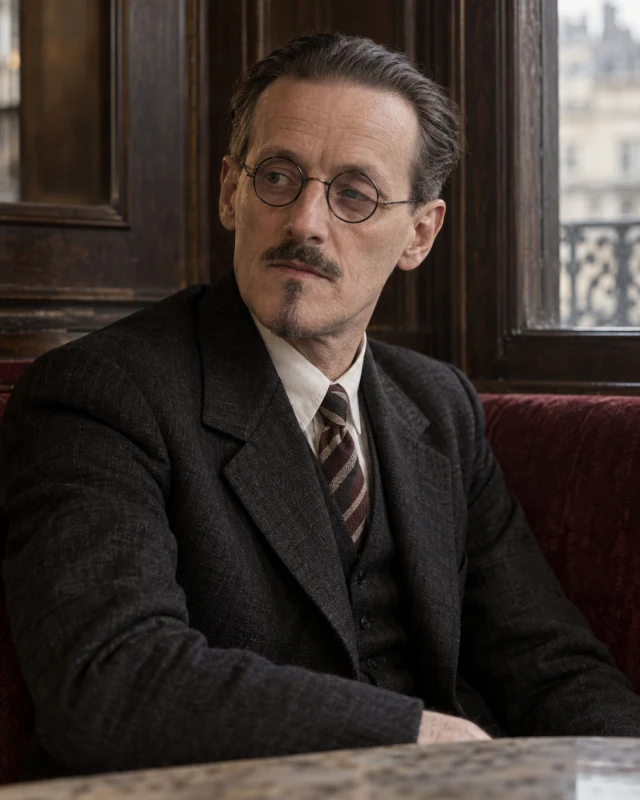
James Joyce Reads Dubliners — In His Own Restored Voice
Source recording: The 'Aeolus' episode of Ulysses, recorded by HMV in Paris, 27 Nov 1924; thirty copies pressed, labelled Shakespeare and Company. A second disc, 'Anna Livia Plurabelle', followed in 1929. Held by: No single holder; copies circulate via the Internet Archive and the Public Domain Review. Copyright: status unresolved on the available evidence — see Voice Rights.
“His soul swooned slowly as he heard the snow falling faintly through the universe.”
About this work
Dubliners (1914) is Joyce's collection of fifteen short stories tracing the city through childhood, adolescence, maturity and public life. Written between 1904 and 1907, it endured a notorious nine-year struggle with timid publishers before Grant Richards finally issued it on 15 June 1914. The stories move from the boy narrators of the opening pieces to the famous closing novella, The Dead, with its snow falling over all of Ireland.
Joyce called his method one of "scrupulous meanness" — plain, exact prose loaded with epiphany. Heard in his own restored Irish voice, the paralysis, longing and sudden revelation of these Dubliners gain a confiding intimacy no neutral narrator can match; you hear the city spoken by the man who carried it in his ear for life.
Who was James Joyce?
James Joyce (1882–1941) was the Dublin-born writer who remade modern fiction. From self-imposed exile in Trieste, Zurich and Paris he wrote with relentless precision about the city he never stopped circling, building from Dubliners and A Portrait of the Artist as a Young Man toward the encyclopedic experiments of Ulysses and Finnegans Wake.
Trained as a singer with a fine tenor voice and an obsessive ear for the music of speech, Joyce heard prose as much as he read it. That musicality — the cadence, the Hiberno-English turn of phrase, the buried rhythm of a Dublin sentence — is exactly what comes alive when his own voice carries the words.
About the voice
This recording restores James Joyce's voice from the only authenticated archival sources that survive: his 1924 reading of the "Aeolus" episode of Ulysses, recorded for Sylvia Beach at the His Master's Voice studio in Paris, and his 1929 reading from Finnegans Wake. Those rare discs are the basis for reconstructing his Dublin tenor and delivery. This is a faithful restoration applied to Dubliners — not a literal new performance by Joyce, who died in 1941.
Provenance: Restored from real recordings. We label every voice honestly — restored, narrated, or disputed.
Questions
What did James Joyce sound like?
Joyce had a light, melodic Irish tenor with crisp Dublin diction and an unmistakable musical cadence — he was a trained singer who once considered a performing career. His surviving 1924 and 1929 recordings reveal a precise, almost incantatory delivery that lingers on the sound of each phrase.
Is this really his voice?
It is an honest restoration built from Joyce's genuine archival recordings — the 1924 Ulysses disc and the 1929 Finnegans Wake reading — not a claim that Joyce is performing today. He died in 1941, so no new recording of him is possible; what you hear reconstructs his documented voice and applies it to Dubliners.
Is Dubliners in the public domain?
Yes. Dubliners was first published in 1914 and is in the public domain in the United States and Canada, so this audiobook can be offered freely and legally.
More iconic voices
Discover more voices
Get free sample recommendations and news about new releases. Unsubscribe at any time.