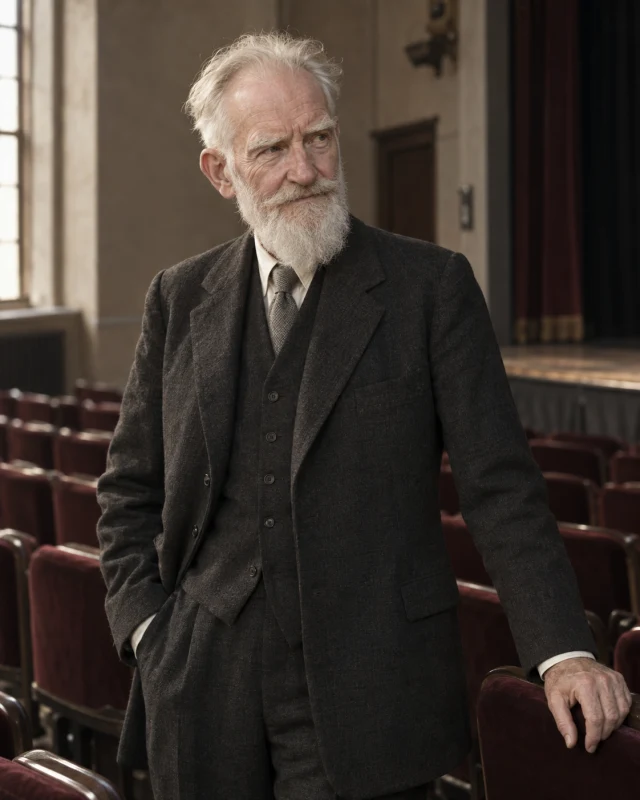
George Bernard Shaw Reads "Pygmalion" — In His Own Voice
Source recording: Linguaphone 'Spoken English and Broken English', London, recorded in the late 1920s (the disc exists; the 1927 date could not be confirmed at source); Fox Movietone newsreel 'Shaw Talks for Movietone News', 1928; BBC talks 1931-37. Held by: Linguaphone; BBC and British Library Sound Archive; Fox Movietone material at USC Moving Image Research Collections. Copyright: still under copyright or held under archive terms — see Voice Rights.
“It is impossible for an Englishman to open his mouth without making some other Englishman hate or despise him.”
About this work
"Pygmalion" (1913) follows phonetics professor Henry Higgins as he wagers that he can pass off a Cockney flower girl, Eliza Doolittle, as a duchess simply by retraining her vowels. It is a comedy about speech, class, and the cruelty of social judgment — Shaw made a phonetics enthusiast his hero precisely because, as his preface argues, an Englishman's accent fixes his fate.
There is a special rightness to hearing this particular play in Shaw's own restored voice. Pygmalion is, at heart, about how a voice can be made or unmade — and Shaw himself was a lifelong student of how the English language ought to sound.
Who was George Bernard Shaw?
George Bernard Shaw (1856–1950) was the wittiest and most quarrelsome dramatist of his age — Nobel laureate, music and theatre critic, Fabian socialist, and inexhaustible public provocateur. Over six decades he turned the English stage into a debating chamber, smuggling arguments about poverty, class, and morality inside some of the funniest plays ever written.
He was also a passionate evangelist for clear speech and an early enthusiast of recording technology. He broadcast regularly over the BBC for almost twenty-five years, cut Linguaphone records to teach English, and made the famous "Spoken English and Broken English" disc — leaving behind one of the richest sound legacies of any author of his era.
About the voice
This recording restores Shaw's voice from his real archival recordings — the BBC broadcasts, Linguaphone discs, and spoken-word records he made during his lifetime, of which a great many survive. It is a reconstruction built from genuine recordings of Shaw himself, not a stand-in narrator and not a suggestion that he is speaking today.
Provenance: Restored from real recordings. We label every voice honestly — restored, narrated, or disputed.
Questions
What did George Bernard Shaw sound like?
Lively, lilting, and faintly Irish beneath the cultivated English — a born performer's voice, crisp and theatrical, preserved on numerous BBC broadcasts and his own elocution records.
Is this really his voice?
It is reconstructed from Shaw's abundant genuine recordings. We restore that real voice to read Pygmalion; we never claim he is literally speaking today.
Is "Pygmalion" in the public domain?
Yes. First published in 1913, the play is in the public domain in the United States.
More iconic voices
Discover more voices
Get free sample recommendations and news about new releases. Unsubscribe at any time.