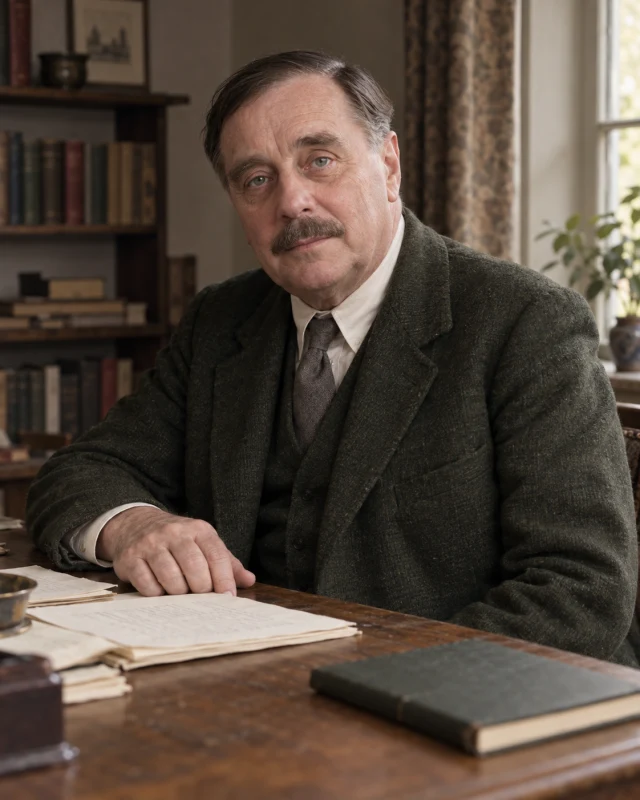
H.G. Wells Reads The Time Machine — In His Own Voice
Source recording: Something over an hour of BBC broadcast talks or fragments; the earliest surviving is a 1934 extract from 'Whither Britain?'. His 1929 radio debut 'World Peace' has not survived as audio. Held by: BBC and British Library Sound Archive (reading-room access); British Pathe. Copyright: still under copyright or held under archive terms — see Voice Rights.
“We are kept keen on the grindstone of pain and necessity.”
About this work
The Time Machine (1895), Wells's first novel, gave the world both the device and the idea of traveling through time as a fourth dimension. Its unnamed Time Traveller journeys to the year 802,701 and finds humanity split into two species — the delicate Eloi and the subterranean Morlocks — a parable of class division carried to its evolutionary extreme, before pressing on to a dying Earth beneath a swollen red sun. Equal parts adventure and sociological warning, it set the template for a century of science fiction.
Hearing it in Wells's own restored voice connects the tale to the mind that conceived it — the biologist-turned-prophet whose real recorded voice can still be heard puzzling over technology and the human future.
Who was H.G. Wells?
H. G. Wells (1866–1946) was an English writer whose early "scientific romances" all but invented modern science fiction — The Time Machine, The War of the Worlds, The Invisible Man, The Island of Doctor Moreau. Trained in biology under T. H. Huxley, he brought an evolutionary, scientific imagination to fiction and, across more than a hundred books, to history, sociology and politics, becoming one of the most widely read public intellectuals of his age.
Wells was also a man of the broadcast era. The BBC preserved recordings of him from the 1930s and 1940s discussing world politics, technology and the shape of things to come — surviving audio that captures his distinctive, high-pitched, faintly Cockney-tinged voice.
About the voice
This is a restored voice edition. Wells's voice genuinely survives in BBC recordings made during the 1930s and 1940s, in which he speaks on politics, science and the future. Those authentic recordings are the basis for reconstructing how Wells sounded; the audio you hear is built from his real archival voice, not a claim that the author is speaking today.
Provenance: Restored from real recordings. We label every voice honestly — restored, narrated, or disputed.
Questions
What did H.G. Wells sound like?
Surviving BBC recordings reveal a surprisingly high-pitched, light voice with a faint Cockney edge — a reflection of Wells's lower-middle-class London origins rather than the gravitas one might expect from the father of science fiction.
Is this really H.G. Wells's voice?
Yes, it is a restoration grounded in genuine recordings. The BBC preserved audio of Wells speaking in the 1930s and 1940s, so authentic source material of his actual voice exists to reconstruct from.
Is The Time Machine in the public domain?
Yes. The Time Machine was published in 1895 and is firmly in the public domain, freely available through sources such as Project Gutenberg.
More iconic voices
Discover more voices
Get free sample recommendations and news about new releases. Unsubscribe at any time.