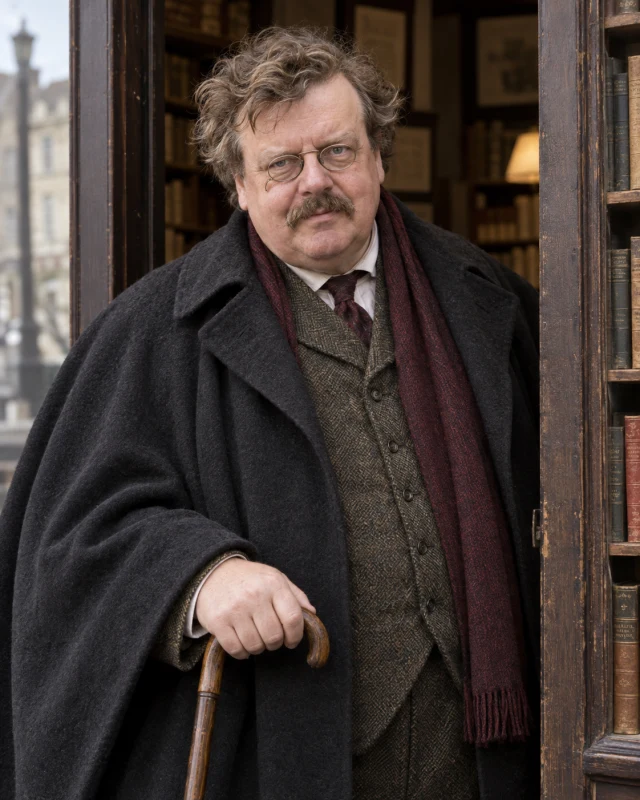
G.K. Chesterton Reads The Man Who Was Thursday — In His Own Restored Voice
Source recording: Three or four short clips only: two from Holy Cross College, Worcester MA (a US fixation, date not established), 'Architecture' (BBC, Jan 1933) and 'The Spice of Life' (BBC Sound Archive, Mar 1936). Held by: BBC Sound Archive; American Chesterton Society compilation; gkc.org.uk. Copyright: still under copyright or held under archive terms — see Voice Rights.
“The most incredible thing about miracles is that they happen.”
About this work
The Man Who Was Thursday: A Nightmare (1908) is Chesterton's strangest and most enduring work of fiction — a metaphysical thriller disguised as a spy caper. A poet-detective named Gabriel Syme infiltrates a secret council of anarchists, each named for a day of the week, only to discover that nothing in this conspiracy is what it seems. Equal parts chase, comedy, and theological riddle, it builds toward one of the most debated endings in modern literature.
To hear it read in Chesterton's own restored voice is to catch the book's true register: the breathless absurdity, the sudden gravity, the laughter underneath the dread. This is a 'nightmare' told by a man who never stopped finding the universe funny — and that voice changes how the whole strange parable lands.
Who was G.K. Chesterton?
Gilbert Keith Chesterton (1874–1936) was one of the most prolific and paradox-loving minds of his age — a journalist, novelist, poet, and Christian apologist who turned out essays, detective stories, and theology with the same exuberant ease. Standing well over six feet and famously rotund, he debated George Bernard Shaw, invented the priest-detective Father Brown, and wrote with a delight in paradox that earned him the title the prince of paradox.
In his final decade Chesterton became a beloved broadcaster on the early BBC, where listeners came to know not just his prose but his voice — warm, booming, and forever on the edge of laughter. He remains one of the most quoted writers in the English language, admired across philosophical and political lines for his wit and his defense of wonder.
About the voice
This narration is reconstructed from G.K. Chesterton's real archival recordings — chiefly his BBC radio broadcasts of the early 1930s, in which his distinctive cadence and timbre were captured. The result is a faithful restoration of how Chesterton actually sounded, used to voice this public-domain text. It is a careful re-creation built from genuine recordings of him, not a claim that Chesterton is literally speaking today.
Provenance: Restored from real recordings. We label every voice honestly — restored, narrated, or disputed.
Questions
What did G.K. Chesterton sound like?
By the accounts of those who heard his BBC broadcasts, Chesterton had a high, surprisingly light voice for so large a man — warm, quick, and habitually amused, as if a joke were always just about to surface. His surviving radio recordings preserve that genial, conversational cadence.
Is this really Chesterton's voice?
It is a restoration built from his real archival BBC recordings, faithfully reconstructed to read this book. We never pretend Chesterton is alive and speaking now — what you hear is an honest re-creation of his documented voice applied to his own words.
Is The Man Who Was Thursday in the public domain?
Yes. The Man Who Was Thursday was published in 1908 and is firmly in the public domain in the United States and Canada, free to read, share, and adapt.
More iconic voices
Discover more voices
Get free sample recommendations and news about new releases. Unsubscribe at any time.