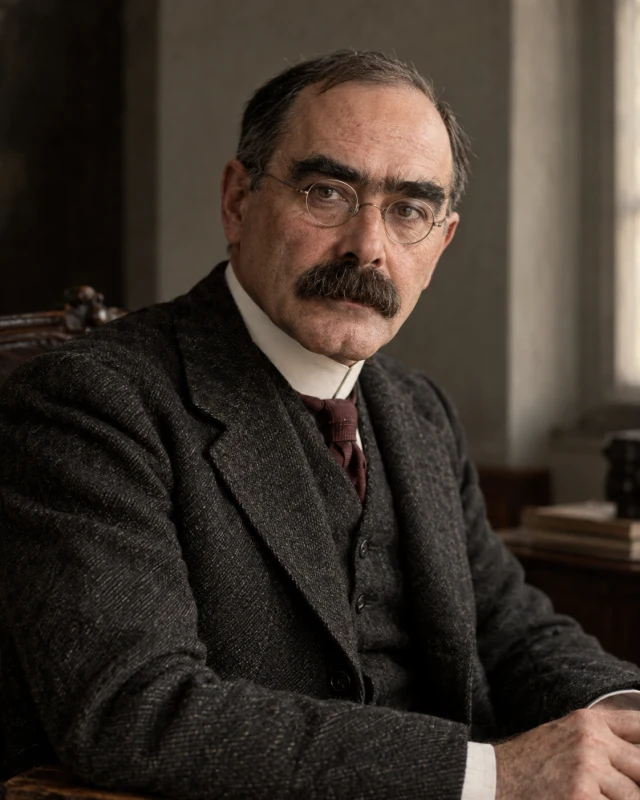
Rudyard Kipling Reads The Jungle Book — In His Own Restored Voice
Source recording: 23 Nov 1921, Musee de la Parole, Paris - the first seven lines of 'France'. The Poetry Archive calls this the only extant recording of Kipling's voice. Held by: Bibliotheque nationale de France (ex-Phonotheque Nationale); the recording reached the public through the British Library's 2003 CD 'The Spoken Word:… Copyright: still under copyright or held under archive terms — see Voice Rights.
“"Now this is the Law of the Jungle—as old and as true as the sky."”
About this work
The Jungle Book (1894) gathers the linked tales of Mowgli, the "man-cub" raised by wolves and tutored by Baloo the bear and Bagheera the black panther, alongside stand-alone stories like the mongoose epic "Rikki-Tikki-Tavi." Kipling built it partly for his own small daughter, and its cadences — the chanted Law of the Jungle, the named animals, the call-and-response of the pack — were engineered for the reading-aloud voice.
That is exactly what makes hearing it in Kipling's own restored voice so striking: this was never silent prose. To hear the man who invented Akela and Shere Khan speak their world is to hear the book as it was first imagined — at the volume of a story told, not a page turned.
Who was Rudyard Kipling?
Rudyard Kipling (1865–1936) was born in Bombay, schooled in England, and made his name as a young journalist in British India, where the heat, languages, and folklore of the subcontinent soaked into everything he wrote. By his thirties he was the most popular writer in the English-speaking world, and in 1907 he became the first English-language author to win the Nobel Prize in Literature.
He wrote with an ear tuned to spoken rhythm — ballads, beast-fables, and barrack-room verse meant to be heard aloud as much as read. The Jungle Book, Kim, the Just So Stories, and poems like "If—" and "Gunga Din" made him a household voice, even as later readers wrestled with the imperial assumptions threaded through his work.
About the voice
This recording restores Rudyard Kipling's voice from the surviving archival audio of the author himself — the only known recording of Kipling's voice was captured in 1921, late in his life. From that thin but genuine trace, his timbre, accent, and delivery are reconstructed to narrate the full text. It is a faithful restoration built on real evidence of how Kipling sounded; it is not a live performance, and Kipling never recorded this book in full during his lifetime.
Provenance: Restored from real recordings. We label every voice honestly — restored, narrated, or disputed.
Questions
What did Rudyard Kipling sound like?
Kipling spoke with the clipped, measured English of his era, shaped by his Anglo-Indian upbringing and a lifetime of reading verse aloud. The single surviving 1921 recording of his voice preserves that careful, rhythmic delivery, which this restoration draws on.
Is this really Kipling's voice?
It is an honest restoration, not a live recording. We reconstruct Kipling's voice from the one authenticated archival recording that survives, then use it to narrate the book. We never claim it is Kipling speaking today — it is his documented voice, restored.
Is The Jungle Book in the public domain?
Yes. The Jungle Book was published in 1894 and is firmly in the public domain in the United States and Canada, so the text can be freely narrated and shared.
More iconic voices
Discover more voices
Get free sample recommendations and news about new releases. Unsubscribe at any time.