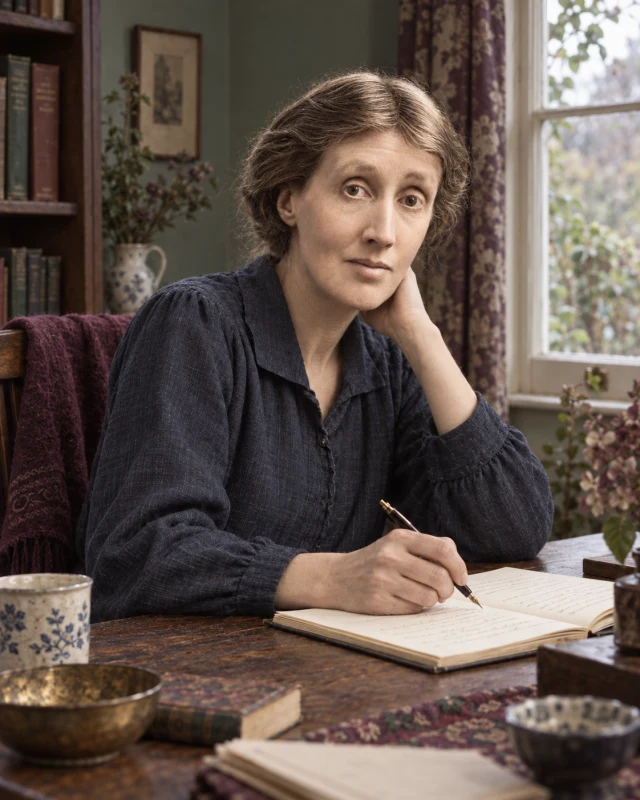
Virginia Woolf Reads Mrs. Dalloway — In Her Own Voice
Source recording: One fragment only: the BBC talk 'Craftsmanship' (Words Fail Me), 29 April 1937. Approximately the final third of the talk was recorded - about seven or eight minutes. It is the only extant recording of her voice. Held by: British Library National Sound Archive, shelfmark M7060W BD1 / BBC Archive No. 1328; typescript at the BBC Written Archives Centre. Copyright: still under copyright or held under archive terms — see Voice Rights.
“Mrs Dalloway said she would buy the flowers herself.”
About this work
Mrs. Dalloway (1925) follows a single June day in post-war London as Clarissa Dalloway prepares to host a party, her thoughts braided with those of the shell-shocked veteran Septimus Warren Smith. From its famous first line — "Mrs Dalloway said she would buy the flowers herself" — the novel moves fluidly between minds, as the chimes of Big Ben mark the hours and the city breathes around its characters. It is one of the defining achievements of the modern novel.
Woolf wrote prose meant to mimic the rhythm of thought itself, and hearing it spoken in her own restored voice returns that prose to the cadence she heard in her head — the rise and fall, the long suspended sentences, the music of consciousness becoming, for once, audible.
Who was Virginia Woolf?
Virginia Woolf (1882–1941) was an English novelist, essayist and critic, a central figure of the Bloomsbury Group and one of the great pioneers of literary modernism. In novels such as Mrs. Dalloway, To the Lighthouse and The Waves, she perfected the stream-of-consciousness technique, dissolving the boundary between a character's outward world and inner life. As an essayist — above all in A Room of One's Own — she became a foundational voice of feminist criticism.
Almost nothing of Woolf's speaking voice survives. A single BBC broadcast from 1937, the talk later published as "Craftsmanship," is the only known recording of her — which makes hearing her at all an unusually intimate encounter.
About the voice
This is a restored voice edition built from the one surviving recording of Virginia Woolf — her 1937 BBC talk "Craftsmanship," the only known audio of her voice. That genuine eight-minute recording is the basis for reconstructing how Woolf sounded; the audio you hear is drawn from her real archival voice, not a claim that she is speaking live today.
Provenance: Restored from real recordings. We label every voice honestly — restored, narrated, or disputed.
Questions
What did Virginia Woolf sound like?
From her single surviving recording — the 1937 BBC talk "Craftsmanship" — Woolf's voice is cultured, precise and unhurried, with the measured English diction of her era. It is the only direct evidence we have of how she spoke.
Is this really Virginia Woolf's voice?
It is a restoration based on the only known recording of her, the 1937 BBC broadcast. We work from that genuine source audio rather than inventing a voice, though it is a reconstruction and not Woolf speaking live.
Is Mrs. Dalloway in the public domain?
Yes. Mrs. Dalloway was published in 1925 and is in the public domain, freely available through sources such as Project Gutenberg.
More iconic voices
Discover more voices
Get free sample recommendations and news about new releases. Unsubscribe at any time.