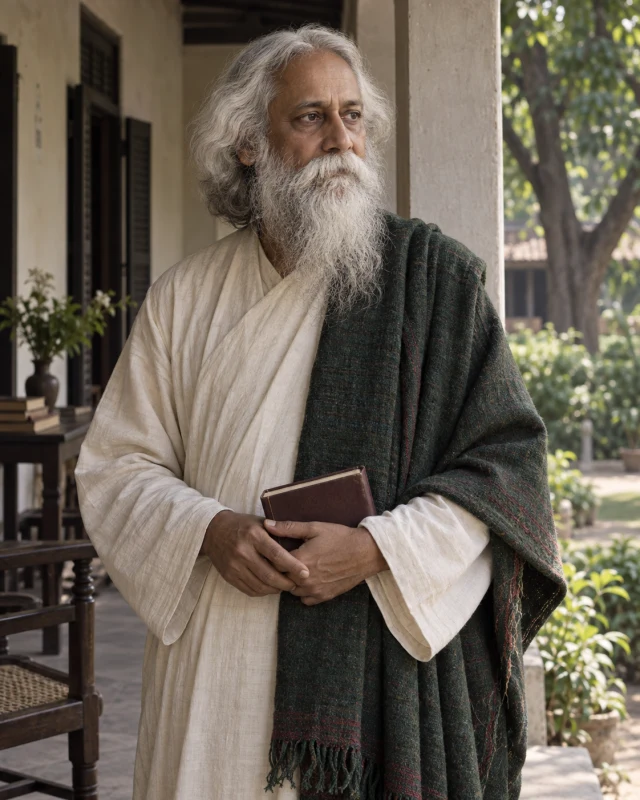
Rabindranath Tagore Reads Gitanjali — In His Own Voice
Source recording: A 1906 Pathe 'Vande Mataram' is reported as the earliest surviving item but the attribution to Tagore's own voice is uncorroborated and it is a 2 min 46 s sung fragment. Held by: Lautarchiv, Humboldt-Universitat zu Berlin (Aut 48, with usage-rights and research-access gating); Gramophone Co / HMV successors; Hindusthan Records… Copyright: still under copyright or held under archive terms — see Voice Rights.
“Where the mind is without fear and the head is held high; / Where knowledge is free... into that heaven of freedom, my Father, let my country awake.”
About this work
Gitanjali — "Song Offerings" — is the collection that carried Tagore's name to the world. He drew the English volume (London, 1912) from his own Bengali devotional lyrics, rendering them himself into a spare, prose-poetry English that W. B. Yeats championed in a famous introduction. A year later it won the Nobel Prize. Its poems address the divine with startling intimacy: the soul as a flute the maker fills with breath, life as a lamp carried toward an unseen shore.
To hear these offerings spoken in Tagore's own cadence is to restore something the printed page can only suggest — the song still living inside the "song offerings," the devotional rhythm of a poet who first composed these lines to be sung, not silently read.
Who was Rabindranath Tagore?
Rabindranath Tagore (1861–1941) was a Bengali poet, composer, philosopher and painter from Calcutta who reshaped the literature and music of the Indian subcontinent. In 1913 he became the first non-European — and the first Asian — to win the Nobel Prize in Literature, awarded for the luminous spirituality of his verse. He wrote thousands of songs (still sung daily across Bengal as Rabindrasangeet), founded the school and university at Santiniketan, and renounced his British knighthood in protest after the 1919 Amritsar massacre.
Tagore was as much a voice as a pen. From the mid-1920s he recorded songs and recitations for the gramophone, and roughly twenty discs of his work — and his speech — survive, making him one of the rare poets of his era whose actual voice can still be heard.
About the voice
This is a restored voice edition. Tagore made real gramophone recordings of his recitations and songs from the mid-1920s until near his death in 1941, and roughly twenty discs survive in archives including the Library of Congress and sound collections in Germany. Those authentic recordings are the basis for reconstructing how Tagore sounded; the audio you hear is built from his genuine archival voice, not a claim that the poet is speaking live today.
Provenance: Restored from real recordings. We label every voice honestly — restored, narrated, or disputed.
Questions
What did Rabindranath Tagore sound like?
Tagore had a deep, measured, musical voice — unsurprising for a man who composed thousands of songs. Surviving gramophone discs from the 1920s and 1930s preserve both his singing and his spoken recitations, giving us a real record of his cadence and tone.
Is this really Tagore's voice?
It is a restoration based on his genuine archival recordings. Tagore personally recorded songs and recitations for the gramophone, so we work from authentic source audio of the poet himself rather than inventing a voice from nothing.
Is Gitanjali in the public domain?
Yes. The English Gitanjali (Song Offerings) was published in 1912 and is in the public domain, freely available through sources such as Project Gutenberg.
More iconic voices
Discover more voices
Get free sample recommendations and news about new releases. Unsubscribe at any time.