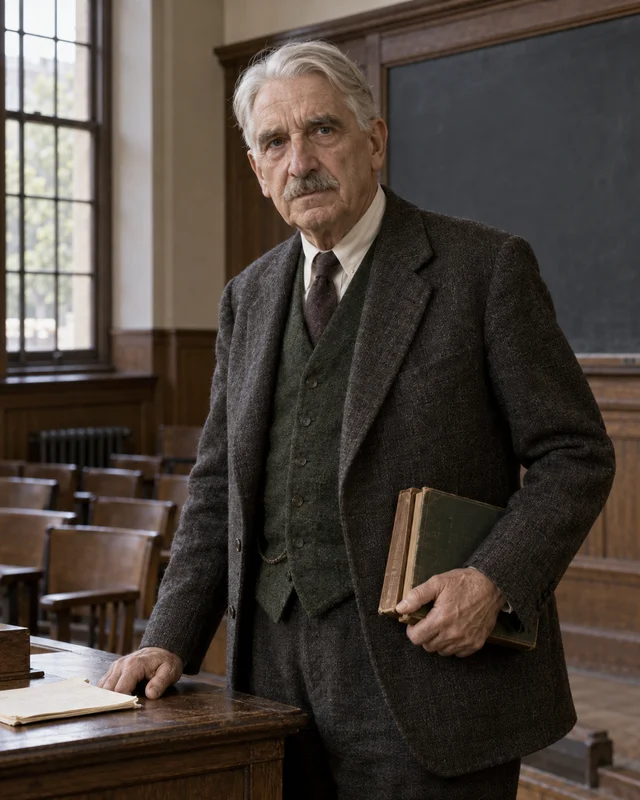
John Dewey Reads Democracy and Education — In His Own Restored Voice
Source recording: About 1940 - Dewey reading from 'Art as Our Heritage'; also 1949 University of Pittsburgh interviews, lectures, family recordings and telephone tapes. Held by: Center for Dewey Studies and the Morris Library Special Collections Research Center, Southern Illinois University Carbondale. Copyright: still under copyright or held under archive terms — see Voice Rights.
“Democracy has to be born anew every generation, and education is its midwife.”
About this work
Democracy and Education: An Introduction to the Philosophy of Education (1916) is the book in which Dewey's whole philosophy is most fully laid out. Its argument is deceptively simple and quietly radical: a democracy is not merely a form of government but a mode of associated living, and it survives only if each generation is educated to think, cooperate, and remake the world rather than just inherit it.
Hearing it read in Dewey's own restored voice changes the experience. The dense, careful sentences slow down and open up; you follow the reasoning the way his students once did in a Columbia lecture hall. It becomes less a textbook and more a conversation with the man who taught a nation how to think about teaching.
Who was John Dewey?
John Dewey (1859–1952) was the most influential American philosopher and educational reformer of his age — a founder of pragmatism alongside William James and Charles Peirce, and the intellectual architect of progressive education. From his laboratory school at the University of Chicago to his decades at Columbia, he insisted that thinking is something we do, that knowledge is tested in action, and that schools are not waiting rooms for adulthood but living communities in their own right.
Over a career spanning seven decades he wrote on logic, art, ethics, psychology, and public life, and weighed in on the great democratic questions of the twentieth century. His prose is plain, patient, and unhurried — the voice of a New England-born thinker who trusted ordinary experience and distrusted easy abstractions.
About the voice
This recording restores John Dewey's voice from genuine archival audio — Dewey was recorded late in life, including a 1940 reading of his own words and lectures and interviews preserved in the Center for Dewey Studies and the Morris Library Special Collections at Southern Illinois University. Those surviving recordings are used to reconstruct his vocal character so the book can be heard in his manner of speaking. This is a faithful restoration, not a claim that Dewey is literally speaking today.
Provenance: Restored from real recordings. We label every voice honestly — restored, narrated, or disputed.
Questions
What did John Dewey sound like?
Surviving recordings capture an unhurried, deliberate American voice — measured and professorial, with the flat, plainspoken cadence of his Vermont upbringing. He spoke the way he wrote: carefully, without flourish, letting the argument carry the weight.
Is this really his voice?
It is a restoration built from real archival recordings of Dewey, who was captured on audio in his later decades. We reconstruct his vocal character from that genuine material — it is an honest restoration of how he sounded, not a recording of him made today.
Is Democracy and Education in the public domain?
Yes. Published in 1916, Democracy and Education is in the public domain in the United States, which is why we can offer it freely narrated in his restored voice.
More iconic voices
Discover more voices
Get free sample recommendations and news about new releases. Unsubscribe at any time.