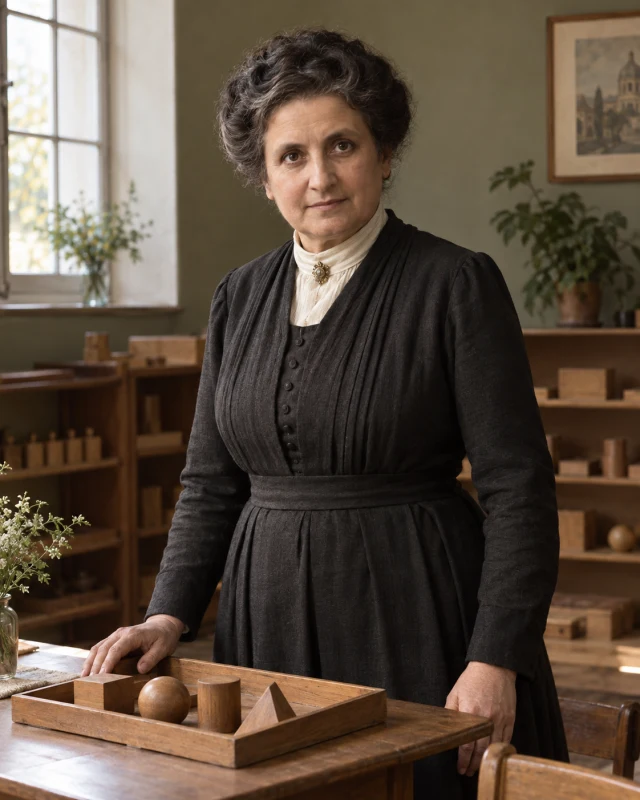
Maria Montessori Reads The Montessori Method — In Her Own Restored Voice
Source recording: A single Dutch radio interview with Gustav Czopp, dated 31 October 1936 by AMI and 1938 on Wikimedia Commons. Length 3 minutes 13 seconds. Held by: AVRO/VPRO Dutch broadcast archive; Association Montessori Internationale (AMI). Copyright: still under copyright or held under archive terms — see Voice Rights.
“The greatest sign of success for a teacher is to be able to say, 'The children are now working as if I did not exist.'”
About this work
The Montessori Method is the book that introduced her revolution to the world. Part scientific report, part manifesto, it describes the prepared environment, the child-sized materials, the long stretches of uninterrupted concentration, and the transformed role of the teacher — from drillmaster to quiet observer. It is where the now-familiar Montessori vocabulary first reaches a wide audience.
To hear it in Montessori's own restored voice is to sit close to the source. The careful observations of children at work carry the warmth and conviction of the woman who watched them first — a physician describing what she saw, and a reformer telling you exactly what it means.
Who was Maria Montessori?
Maria Montessori (1870–1952) was one of the first women to qualify as a physician in Italy, and she brought a doctor's eye for observation to the question of how children learn. Working first with children others had written off, then in her famous Casa dei Bambini in a poor Roman neighborhood, she discovered that when you give a child a prepared environment and the freedom to choose meaningful work, an astonishing self-discipline and joy emerge on their own.
Her insight — follow the child — spread across the world and reshaped early education on every continent. Nominated three times for the Nobel Peace Prize, she spent her final decades lecturing on education as the foundation of peace, convinced that the way we treat children is the way we will one day treat one another.
About the voice
This recording restores Maria Montessori's voice from genuine archival audio. She was recorded in her later years — most notably her 1950 lecture in Amsterdam's Bach auditorium, captured by Dutch radio, and surviving interview footage held in the Association Montessori Internationale archives. Her vocal character is reconstructed from that real material so her book can be heard in her own manner of speaking. This is a faithful restoration, not a claim that she is literally speaking today.
Provenance: Restored from real recordings. We label every voice honestly — restored, narrated, or disputed.
Questions
What did Maria Montessori sound like?
Archival recordings preserve a poised, deliberate Italian voice, often speaking in accented English or Italian to international audiences — the measured, persuasive delivery of a physician and lecturer used to commanding a hall, warmed by genuine feeling for children.
Is this really her voice?
It is a restoration drawn from real archival recordings of Montessori, including her 1950 Amsterdam lecture and surviving interview footage. We reconstruct her vocal character from that genuine audio — an honest restoration of how she sounded, not a new recording of her.
Is The Montessori Method in the public domain?
Yes. The Montessori Method, first published in English in 1912, is in the public domain in the United States, which is why we can offer it narrated in her restored voice.
More iconic voices
Discover more voices
Get free sample recommendations and news about new releases. Unsubscribe at any time.