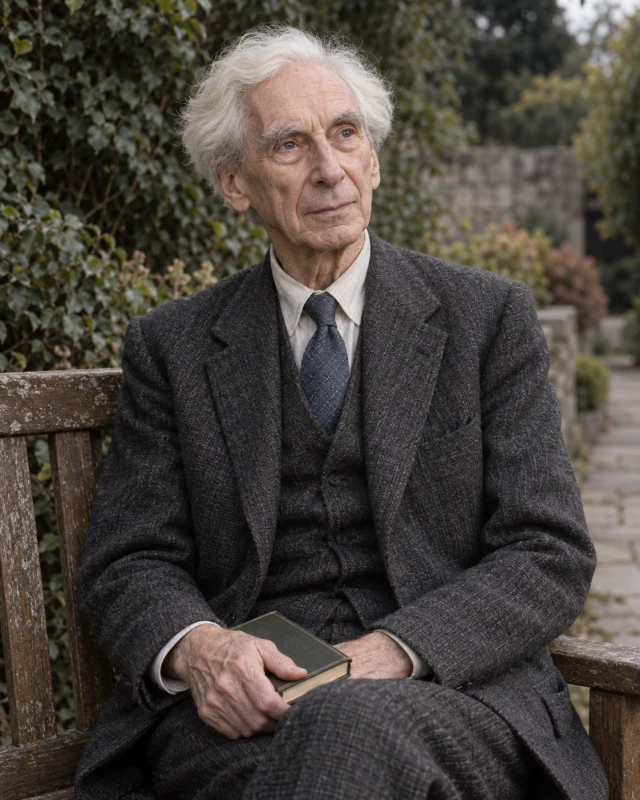
Bertrand Russell Reads The Problems of Philosophy — In His Own Voice
Source recording: 1938 'Taming Economic Power' is the earliest listed; then 1939, 1941, 1945; 28 Jan 1948 Copleston debate; 26 Dec 1948 first Reith Lectures; 18 Dec 1950 Nobel; 1959 Face to Face; 1960s home tapes. Held by: BBC; Bertrand Russell Archives, McMaster University; British Library Sound Archive; UNESCO Archives (tape #823); Caedmon LPs (now HarperCollins); Paci… Copyright: still under copyright or held under archive terms — see Voice Rights.
“Philosophy is to be studied, not for the sake of any definite answers to its questions, but rather for the sake of the questions themselves.”
About this work
The Problems of Philosophy, published in 1912, is Russell's short, luminous introduction to the central questions of the subject: what can we really know, how do appearance and reality differ, and what is the value of philosophical inquiry at all. It remains one of the most widely assigned entry points to philosophy in the English-speaking world.
Hearing it in Russell's own restored voice changes the experience entirely. The clipped Edwardian diction, the dry wit, the careful unfolding of an argument step by careful step — these were the hallmarks of how Russell actually thought aloud. The famous closing chapter on the value of philosophy lands differently when it sounds like the man himself making the case.
Who was Bertrand Russell?
Bertrand Russell was a British philosopher, logician, mathematician and essayist whose work reshaped modern thought. With Alfred North Whitehead he wrote Principia Mathematica, an attempt to ground mathematics in logic, and he later won the 1950 Nobel Prize in Literature for writing that championed humanitarian ideals and freedom of thought.
He was also one of the most recognizable public voices of his century — a frequent BBC broadcaster, delivered the inaugural Reith Lectures in 1948, and a fearless campaigner against war and nuclear weapons well into his nineties. That restless, precise, faintly mischievous intelligence comes through every time he speaks.
About the voice
This narration is reconstructed from Bertrand Russell's real archival recordings. Russell spoke widely on radio and in interviews across decades — including his BBC broadcasts and the 1948 Reith Lectures — leaving a rich record of his actual voice. We use those genuine recordings to restore his vocal character for this reading. It is a careful restoration built on real audio of Russell, not a claim that he is speaking live today.
Provenance: Restored from real recordings. We label every voice honestly — restored, narrated, or disputed.
Questions
What did Bertrand Russell sound like?
Russell had a crisp, high, precise upper-class English voice with deliberate pacing and a dry, often playful edge. Decades of surviving radio broadcasts and interviews preserve it clearly, which is what makes a faithful restoration possible.
Is this really his voice?
It is a restoration built from Russell's genuine archival recordings — we model his real vocal characteristics rather than have him literally read today. The aim is to faithfully convey how he actually sounded, not to fabricate a live performance.
Is The Problems of Philosophy in the public domain?
Yes. Published in 1912, the text is in the public domain in the United States and Canada, which is why we are able to offer this audiobook edition freely as a restored-voice reading.
More iconic voices
Discover more voices
Get free sample recommendations and news about new releases. Unsubscribe at any time.