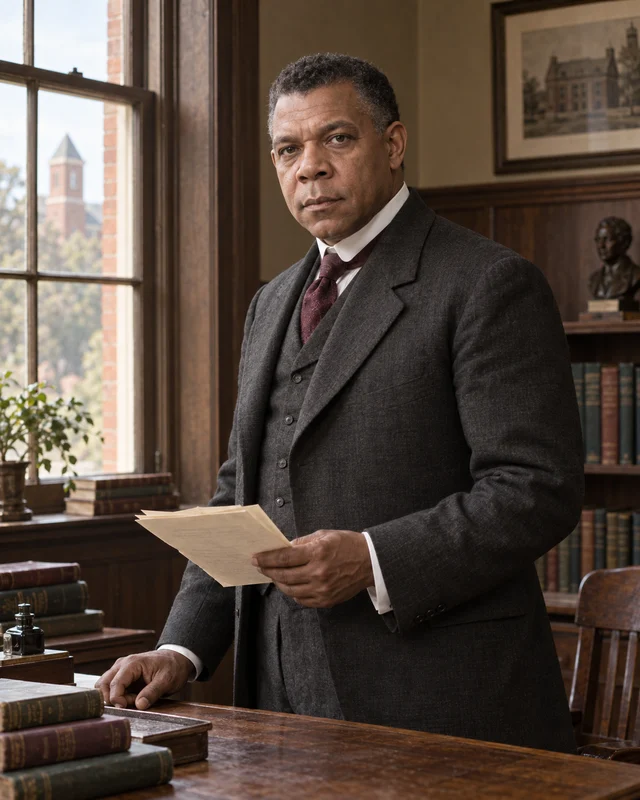
Booker T. Washington Reads "Up from Slavery" — In His Own Voice
Source recording: 5 December 1908, at a Columbia Phonograph studio, catalogued in the Columbia Acoustic Matrix Series as 14605 - a 3 min 20 s studio re-creation of the 1895 Atlanta Exposition address, not a live 1895 capture. Held by: Library of Congress (National Recording Registry, 2002); NARA holds a reel-to-reel copy of a later radio broadcast; original Columbia and Broome press… Copyright: appears to be in the US public domain — see Voice Rights.
“Success is to be measured not so much by the position that one has reached in life as by the obstacles which he has overcome.”
About this work
Up from Slavery, published in 1901, is Washington's classic autobiography and one of the most widely read American memoirs ever written. It traces his journey from enslavement during the Civil War, through the obstacles he overcame to gain an education, to the founding and building of Tuskegee. A best-seller in its day, it remained the most popular African American autobiography until The Autobiography of Malcolm X in 1965.
To hear it in Washington's own restored voice changes the experience entirely. The measured, deliberate self-presentation that shaped his public life — and the philosophy embedded in it — lands differently when carried by the actual cadence of the man who lived the story.
Who was Booker T. Washington?
Booker T. Washington (1856–1915) was born into slavery on a Virginia farm and rose to become the most influential African American leader of his era. After emancipation he worked in salt furnaces and coal mines as a boy, walked and worked his way to an education at Hampton Institute, and in 1881 founded the Tuskegee Institute in Alabama, building it from a shanty and a handful of students into a renowned center of vocational and teacher training.
Adviser to presidents and a tireless fundraiser, Washington became famous — and, to later critics including W. E. B. Du Bois, controversial — for the gradualist philosophy of his 1895 Atlanta address. He remains one of the defining and most debated figures in American history, and the rare recording he left lets us hear that voice for ourselves.
About the voice
This reading restores Washington's voice from the only known sound recording he ever made: a Columbia studio disc of an excerpt from his Atlanta Exposition address, later included in the United States National Recording Registry. Because that fragment is the sole surviving audio of his voice, its documented qualities are used to carry the full text of Up from Slavery. This is a faithful reconstruction grounded in a real recording — not a claim that Washington is speaking today.
Provenance: Restored from real recordings. We label every voice honestly — restored, narrated, or disputed.
Questions
What did Booker T. Washington sound like?
We know because a real recording survives — a roughly three-and-a-half-minute Columbia disc of part of his Atlanta Exposition speech, the only known audio of his voice. It preserves a formal, measured, carefully enunciated delivery, the orator's cadence that made him one of the most sought-after speakers of his day.
Is this really his voice?
It is restored from that genuine archival recording, not fabricated. Washington left exactly one known disc of his own speech, now in the National Recording Registry; we use its documented vocal qualities to read the full memoir. We do not claim the living man is narrating to you.
Is Up from Slavery in the public domain?
Yes. Published in 1901, Up from Slavery has long been in the public domain in the United States and Canada, which is why this complete reading can be offered freely as an artifact.
More iconic voices
Discover more voices
Get free sample recommendations and news about new releases. Unsubscribe at any time.