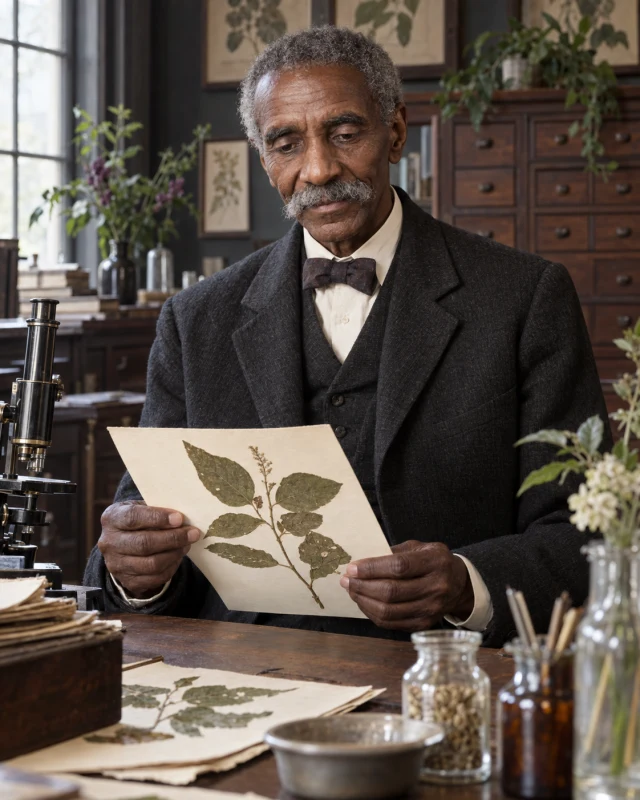
In the author’s own restored voice

George Washington Carver Reads "The Peanut Plant" — In His Own Restored Voice

1864–1943 · Agricultural Science & Botany Restored from real recordings Word-accuracy 95.1%
Press play — the words light up in gold as George Washington Carver reads. This sample is free.
Full unabridged audiobook in this voice — coming soon. The public-domain text is free everywhere; what you’re paying for is the voice, the restoration, and the curation.
“Where there is no vision, there is no hope.”

About this work

"The Peanut Plant" belongs to the family of Tuskegee Agricultural Experiment Station bulletins through which Carver taught the South to see a despised little legume as salvation for exhausted soil and empty tables. His most celebrated bulletin, How to Grow the Peanut and 105 Ways of Preparing It for Human Consumption (1916, reissued 1925), moves from how to plant and harvest the crop straight into recipes and uses — the same "threefold" voice he aimed at farmer, teacher, and cook.

To hear this material in Carver's own restored voice is to sit in his Tuskegee classroom. The science is practical and patient; the tone is that of a man who genuinely wanted his listeners to thrive. It transforms a dry agricultural pamphlet into something closer to a sermon on stewardship and self-reliance.

Who was George Washington Carver?

George Washington Carver was born into slavery in Diamond, Missouri, around 1864 and rose to become one of America's most beloved scientists, botanists, and teachers. For nearly five decades he led the agriculture program at Tuskegee Institute, where he urged poor Southern farmers — many of them recently freed or the children of the enslaved — to restore their boll-weevil-ravaged soil by rotating cotton with peanuts and sweet potatoes.

What made Carver extraordinary was not only the laboratory but the pulpit-like gentleness of his teaching. He published plain-spoken bulletins for the farmer, the teacher, and the housewife alike, and he became famous worldwide for finding hundreds of practical uses for the peanut. He refused to patent most of his discoveries, believing knowledge that fed people should belong to everyone.

About the voice

This recording reconstructs Carver's voice from his real surviving audio. Carver was captured on disc late in life — including a 1941 address and a 1942 recording of him reciting Edgar Guest's poem "Equipment," preserved by the Smithsonian and the Tuskegee University Archives. His restored voice is built from that genuine archival material; it is not a claim that Carver is speaking live today, but a careful reconstruction of how he actually sounded reading his own work.

Provenance: Restored from real recordings. We label every voice honestly — restored, narrated, or disputed.

Questions

What did George Washington Carver sound like?

Surprisingly soft and high-pitched. Listeners are often startled — Carver had a gentle, almost reedy voice with the unhurried cadence of a patient teacher, audible in his surviving 1941 and 1942 recordings.

Is this really his voice?

It is a restoration built from Carver's genuine archival recordings. We are honest about this: it reconstructs how he actually sounded from real audio that survives in the Smithsonian and Tuskegee archives. It is not a live performance or an impersonation.

Is Carver's work in the public domain?

Yes. Carver's early Tuskegee bulletins, including his peanut publications from the 1910s and 1920s, are in the public domain in the United States.

More iconic voices

Hear George Washington Carver read — free

Get the full first chapter in this restored voice, free — plus one new voice from history every week. No spam.