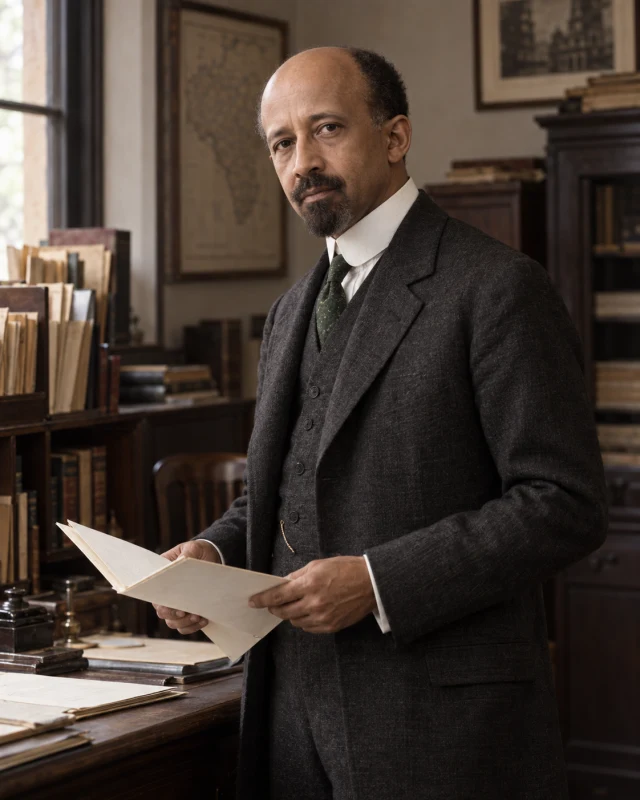
W. E. B. Du Bois Reads The Souls of Black Folk — In His Own Restored Voice
Source recording: 'A Recorded Autobiography - Interview with Moses Asch', Folkways FH 5511, 1961, about 71 minutes. Held by: Smithsonian Institution / Smithsonian Folkways (which bought Folkways from the Asch estate in 1987); University of Massachusetts Amherst for the paper… Copyright: still under copyright or held under archive terms — see Voice Rights.
“The problem of the twentieth century is the problem of the color-line.”
About this work
The Souls of Black Folk (1903) is his masterpiece and one of the foundational texts of American literature and social thought. In fourteen essays — braided with bars of the sorrow songs — he describes what it means to live behind the veil, to feel one's identity split by a hostile world's gaze, and to insist on full humanity all the same. It opens with the sentence that defined a century: the problem of the color line.
To hear it read in Du Bois's own restored voice is to feel why contemporaries called his speech "most pleasant to the ear." The grief and grandeur of the prose, written to be heard as much as read, comes alive in the deliberate, dignified delivery of the man who lived its argument.
Who was W. E. B. Du Bois?
W. E. B. Du Bois (1868–1963) was a sociologist, historian, and the towering intellectual of the early civil rights movement. The first African American to earn a doctorate from Harvard, he pioneered empirical social science in America with studies like The Philadelphia Negro, co-founded the NAACP, and edited its magazine The Crisis for a quarter century. For more than sixty years his pen shaped how the nation argued about race.
He gave the language of race its enduring vocabulary — the color line, the veil, double consciousness — and fused the rigor of the scholar with the cadence of the preacher and the poet. He remained a fearless dissenter to the end, dying in Ghana in 1963 on the eve of the March on Washington.
About the voice
This recording restores W. E. B. Du Bois's voice from genuine archival audio. Du Bois was recorded later in his long life — Smithsonian Folkways preserves his 1960 speech "Socialism and the American Negro" and a 1961 oral-history interview, among other surviving recordings. His vocal character is reconstructed from that real material so this 1903 work can be heard in his own manner of speaking. This is a faithful restoration, not a claim that he is literally speaking today.
Provenance: Restored from real recordings. We label every voice honestly — restored, narrated, or disputed.
Questions
What did W. E. B. Du Bois sound like?
Surviving recordings reveal a precise, dignified, almost courtly voice — carefully enunciated, with the measured authority of the scholar and the resonance of a man trained in oratory. Contemporaries described his speaking as 'most pleasant to the ear.'
Is this really his voice?
It is a restoration built from real archival recordings of Du Bois, including speeches and an interview preserved by Smithsonian Folkways from around 1960–61. We reconstruct his vocal character from that genuine audio — an honest restoration of how he sounded, not a recording made today.
Is The Souls of Black Folk in the public domain?
Yes. Published in 1903, The Souls of Black Folk is firmly in the public domain in the United States, which is why we can offer it narrated in his restored voice.
More iconic voices
Discover more voices
Get free sample recommendations and news about new releases. Unsubscribe at any time.