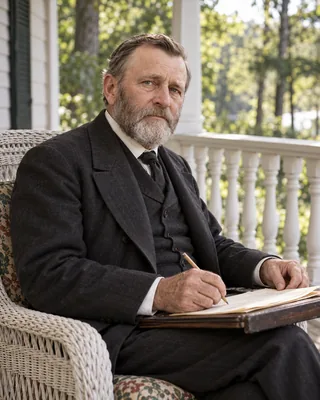
Personal Memoirs of U. S. Grant — narrated by a designed AI voice
Press play — the AI narration lights up word by word. This sample is free.
Read the transcript
When I went into the house I found General Lee. We greeted each other, and after shaking hands took our seats. I had my staff with me, a good portion of whom were in the room during the whole of the interview. What General Lee's feelings were I do not know. As he was a man of much dignity, with an impassible face, it was impossible to say whether he felt inwardly glad that the end had finally come, or felt sad over the result, and was too manly to show it. Whatever his feelings, they were entirely concealed from my observation; but my own feelings, which had been quite jubilant on the receipt of his letter, were sad and depressed. I felt like anything rather than rejoicing at the downfall of a foe who had fought so long and valiantly, and had suffered so much for a cause, though that cause was, I believe, one of the worst for which a people ever fought, and one for which there was the least excuse. I do not question, however, the sincerity of the great mass of those who were opposed to us.
“I feel that we are on the eve of a new era, when there is to be great harmony between the Federal and Confederate.”
About this work
Personal Memoirs of U. S. Grant were published in two volumes in 1885 and 1886 by Charles L. Webster & Company, Mark Twain's publishing house. Grant writes about his Ohio boyhood, West Point and the Mexican War, then the Civil War campaigns from Belmont and Fort Donelson to Vicksburg, Chattanooga, the Overland Campaign and Appomattox.
The prose is famously plain and exact, and it holds up well when heard aloud, one campaign at a time.
Who was Ulysses S. Grant?
Ulysses S. Grant (1822–1885) was an Ohio tanner's son who graduated from West Point, served in the Mexican War and left the army in 1854, then struggled for years as a farmer and clerk. The Civil War made him: victories at Fort Donelson, Vicksburg and Chattanooga brought him command of all the Union armies, and in April 1865 he accepted Robert E. Lee's surrender at Appomattox.
Elected the eighteenth president in 1868, he served two terms marked by Reconstruction and by scandals among his appointees. Ruined by a fraudulent investment firm and dying of throat cancer, he wrote his memoirs against the clock and finished them days before his death in July 1885. Their sales provided for his family.
About the voice
This edition uses a designed AI voice: a new voice generated from a written description of Ulysses S. Grant’s voice, not cloned from any recording of the author. It is not a recording of Ulysses S. Grant reading this work.
Provenance: Designed AI voice — designed from a written description, not cloned from any recording of the author. We label every voice by how it was made for this edition — restored, designed, studio AI, or disputed.
Questions
Is this Ulysses S. Grant’s recorded voice?
No. This edition uses a designed AI voice: a new voice generated from a written description of Ulysses S. Grant’s voice, not cloned from any recording of the author. It is not a recording of Ulysses S. Grant reading this work.
Are the Personal Memoirs of U. S. Grant in the public domain?
Yes. Published in 1885 and 1886, they are in the public domain in the United States; availability varies by country.
More AI voices
Discover more voices
Get free sample recommendations and news about new releases. Unsubscribe at any time.