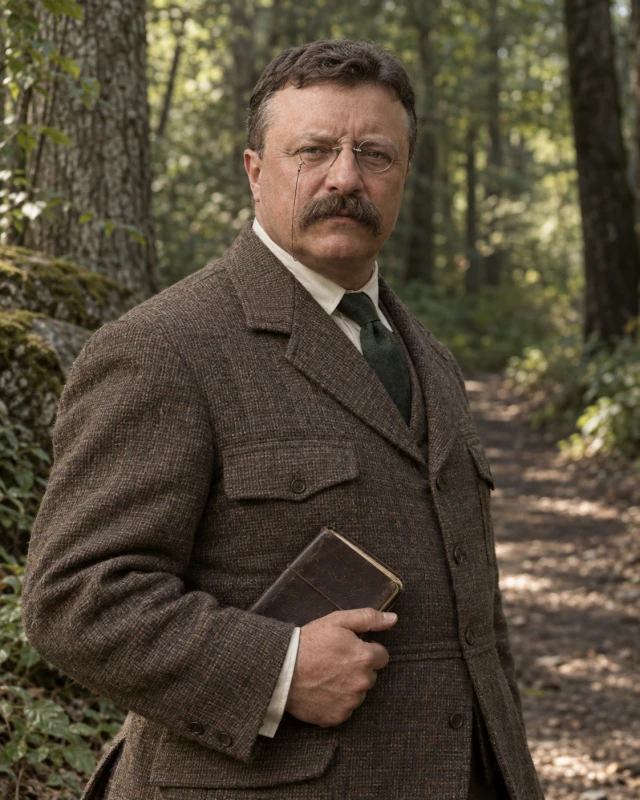
Theodore Roosevelt Reads The Rough Riders — In His Own Restored Voice
Source recording: Cylinders recorded August 1912 at Sagamore Hill, Oyster Bay NY, issued as Edison Blue Amberol 3707 in September 1912; plus five 78 rpm sides for the Victor Talking Machine Company the same year - per the Library of Congress, 'the only sound recordings he made… Held by: Thomas Edison National Historical Park (NPS); Library of Congress MBRS/NAVCC (1982 Theodore Roosevelt Association preservation masters; the original c… Copyright: appears to be in the US public domain — see Voice Rights.
“Far better it is to dare mighty things, to win glorious triumphs, even though checkered by failure, than to take rank with those poor spirits who neither enjoy much nor suffer much.”
About this work
The Rough Riders (1899) is Roosevelt's first-person account of the regiment he helped raise and lead in the Spanish–American War — the 1st United States Volunteer Cavalry, a wild mix of Ivy League athletes, cowboys, lawmen, and frontiersmen. It culminates in the celebrated charge up Kettle and San Juan Heights, the action that made Roosevelt a national hero and launched him toward the presidency.
Vivid, immodest, and unmistakably his, the book reads like Roosevelt talking — and that is exactly why hearing it in his own restored voice is so striking. The famous high, clipped, machine-gun delivery turns the battlefield narrative into something electric, as if the colonel himself were recounting the charge to a room he fully intends to win over.
Who was Theodore Roosevelt?
Theodore Roosevelt (1858–1919) packed several lifetimes into one: sickly asthmatic child turned boxer and rancher, New York police commissioner, Assistant Secretary of the Navy, cavalry colonel, war hero, governor, and — at forty-two — the youngest man ever to become President of the United States. He busted trusts, championed the national parks, brokered peace between Russia and Japan, and won the Nobel Peace Prize, all while writing some forty books.
Roosevelt was a force of pure energy, famous for his glasses, his teeth, his shouted enthusiasms, and his creed of the 'strenuous life.' He left office still hungry for action, hunting in Africa and exploring uncharted Amazon rivers. Few public figures of his century were so completely, theatrically alive — and he made sure his own version of events was the one that got written down.
About the voice
This narration is reconstructed from Theodore Roosevelt's real archival recordings — the campaign speech discs he recorded in 1912 and other surviving audio that preserve his distinctive pitch and cadence. From these genuine recordings his voice is faithfully restored to read this public-domain text. It is an honest re-creation of how Roosevelt actually sounded, not a claim that he is speaking today.
Provenance: Restored from real recordings. We label every voice honestly — restored, narrated, or disputed.
Questions
What did Theodore Roosevelt sound like?
Listeners are often surprised: Roosevelt's surviving 1912 recordings reveal a high, almost reedy tenor, clipped and rapid, biting off each phrase with enormous emphasis. It is the voice of a man in a hurry to convince you, and it carries the same charging energy as his prose.
Is this really Roosevelt's voice?
It is a faithful restoration built from his genuine 1912 campaign recordings, used to narrate this book. We never claim Roosevelt is alive and speaking now — what you hear is an honest reconstruction of his documented voice reading his own account.
Is The Rough Riders in the public domain?
Yes. The Rough Riders was published in 1899 and is in the public domain in the United States and Canada, free to read, share, and adapt.
More iconic voices
Discover more voices
Get free sample recommendations and news about new releases. Unsubscribe at any time.