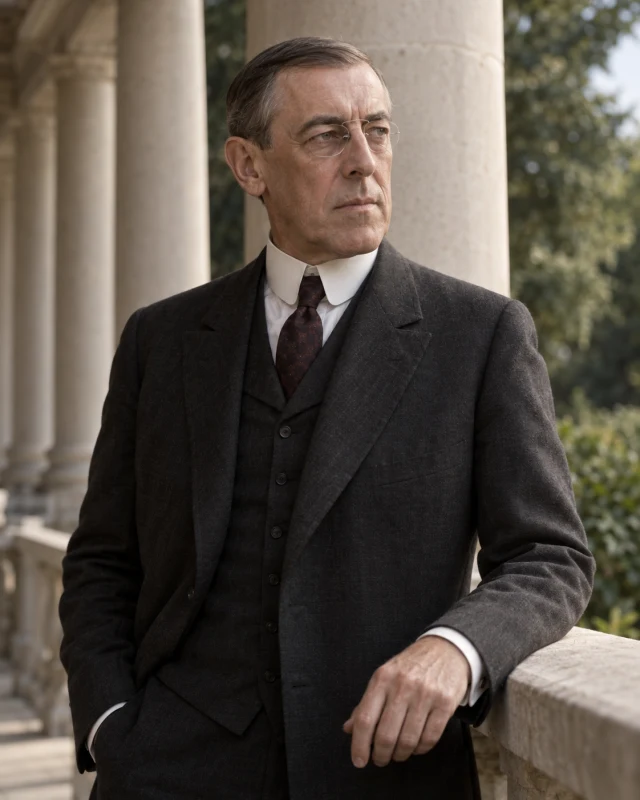
Woodrow Wilson Reads The New Freedom — In His Own Voice
Source recording: 7 August 1912 - 'Woodrow Wilson on democratic principles', an excerpt of his speech accepting the Democratic nomination; the Library of Congress National Jukebox record gives date 1912 and label VICTOR. Held by: Library of Congress National Jukebox (items jukebox-132125, -132126, -132128, -132129, -132131); Sony as successor to the Victor catalogue (an access… Copyright: appears to be in the US public domain — see Voice Rights.
“The history of liberty is a history of the limitation of governmental power, not the increase of it.”
About this work
The New Freedom (1913) is Wilson's progressive manifesto, drawn from the campaign speeches that carried him to the White House in 1912. Its chapters — "The Old Order Changeth," "What Is Progress?," "Freemen Need No Guardians," "Monopoly, or Opportunity?" — argue that a new industrial society had outgrown its old rules, and that the task of reform was not to grow government for its own sake but to break up monopoly and set the "generous energies" of ordinary people free.
It is the founding document of Wilsonian progressivism, and it reads as a direct address to the citizen. Heard in Wilson's own restored voice, the book recovers what it was built to be: not a treatise but a stump speech — the scholar-president making his case to the country, plainly and out loud.
Who was Woodrow Wilson?
Woodrow Wilson (1856–1924) was a Princeton scholar of government who became its president, then governor of New Jersey, then the 28th President of the United States. The only U.S. president to hold a doctorate, he carried the cadence of the lecture hall into politics — measured, moralistic, and architecturally precise. His two terms brought the Federal Reserve, the income tax, antitrust reform, American entry into the First World War, and the doomed campaign for the League of Nations that won him the Nobel Peace Prize.
Wilson is also one of the more searching and contested figures of the era, a reformer whose record on race remains a sharp mark against him. As a speaker he was famous for the clean, persuasive sweep of his prose — sermon-like, confident, built to carry a moral argument. "The history of liberty," he insisted, "is a history of the limitation of governmental power."
About the voice
This recording uses a voice digitally reconstructed from Woodrow Wilson's real archival recordings. In September 1912 Wilson recorded a series of campaign addresses for Thomas Edison's company — including "On Labor" and "On the Tariff" — and those genuine cylinders preserve his actual speaking voice. They are the source material for this restored narration. This is not a live performance and not Wilson speaking today; it is a faithful reconstruction of his documented voice applied to the text of The New Freedom.
Provenance: Restored from real recordings. We label every voice honestly — restored, narrated, or disputed.
Questions
What did Woodrow Wilson sound like?
Clear, formal, and lecture-like, with the careful diction of a professor making an argument. His surviving 1912 Victor recordings show a measured, sermon-flavored delivery — earnest and deliberate rather than fiery. He sounds like a man used to persuading by reasoning rather than shouting.
Is this really Woodrow Wilson's voice?
It is a voice reconstructed from Wilson's real archival recordings, not a new performance by him. Wilson recorded a series of campaign addresses for Victor in 1912 — they survive as discs in the Library of Congress National Jukebox — and those genuine recordings are the basis for this restored narration. We don't claim he is speaking today — this is a faithful reconstruction of his documented voice.
Is The New Freedom in the public domain?
Yes. The New Freedom was published in 1913 and is in the public domain in the United States. The full text is freely available, including through Project Gutenberg, and can be adapted into audio like this edition.
More iconic voices
Discover more voices
Get free sample recommendations and news about new releases. Unsubscribe at any time.