Selected Speeches and Letters — narrated by a designed AI voice
Press play — the AI narration lights up word by word. This sample is free.
Read the transcript
Fondly do we hope, fervently do we pray, that this mighty scourge of war may speedily pass away. Yet, if God wills that it continue until all the wealth piled by the bondsman's two hundred and fifty years of unrequited toil shall be sunk, and until every drop of blood drawn with the lash shall be paid by another drawn with the sword, as was said three thousand years ago, so still it must be said, "The judgments of the Lord are true and righteous altogether." With malice toward none, with charity for all, with firmness in the right as God gives us to see the right, let us strive on to finish the work we are in, to bind up the nation's wounds, to care for him who shall have borne the battle and for his widow and his orphan, to do all which may achieve and cherish a just and lasting peace among ourselves and with all nations.
“With malice toward none, with charity for all, with firmness in the right as God gives us to see the right.”
About this work
Selected Speeches and Letters gathers eighteen of Lincoln's own texts from 1838 to 1865: the Lyceum Address, passages from the Peoria speech of 1854, the letter to Joshua Speed on slavery, the "House Divided" and Cooper Institute speeches, the letter to Grace Bedell, the farewell to Springfield, both inaugural addresses, passages from the message to Congress of July 1861 and the annual message of December 1862, the Emancipation Proclamation, the Gettysburg Address, his letters to Greeley, Hooker, Conkling and Hodges, and his last public address. The texts follow the Constitutional Edition of his papers and writings.
Most of these were written to be spoken, and they gain from being heard in full rather than quoted in fragments.
The free sample on this page is the close of the Second Inaugural Address, delivered on March 4, 1865.
Who was Abraham Lincoln?
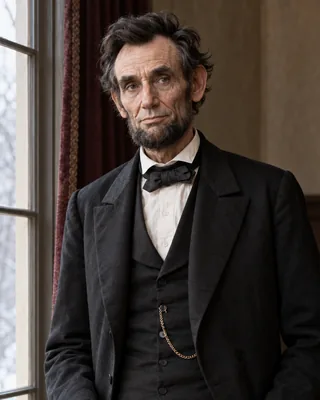
Abraham Lincoln (1809–1865) grew up on the Kentucky and Indiana frontier with less than a year of formal schooling, taught himself law, and became a lawyer and legislator in Illinois. His 1858 Senate debates with Stephen A. Douglas made him a national figure, and in 1860 he was elected the sixteenth president of the United States.
He led the Union through the Civil War, issued the Emancipation Proclamation in 1863 and pressed for the Thirteenth Amendment abolishing slavery. Days after Lee's surrender in April 1865 he was shot at Ford's Theatre in Washington and died the next morning. His speeches and letters are among the most quoted writing in American history.
About the voice
This edition uses a designed AI voice: a new voice generated from a written description of Abraham Lincoln’s voice, not cloned from any recording of the author. It is not a recording of Abraham Lincoln reading this work.
Provenance: Designed AI voice — designed from a written description, not cloned from any recording of the author. We label every voice by how it was made for this edition — restored, designed, studio AI, or disputed.
Questions
What did Abraham Lincoln sound like?
No recording exists: Lincoln died twelve years before the phonograph was invented. People who heard him described a high tenor voice, thin and sharp at first, that carried remarkably well across outdoor crowds. The designed voice on this page is deliberately lower and warmer than those accounts: an artistic choice, not an attempt to match his real voice.
Is this Abraham Lincoln’s recorded voice?
No. This edition uses a designed AI voice: a new voice generated from a written description of Abraham Lincoln’s voice, not cloned from any recording of the author. It is not a recording of Abraham Lincoln reading this work.
Are Lincoln's speeches and letters in the public domain?
Yes. They date from 1838 to 1865 and are in the public domain in the United States; availability varies by country.
More AI voices
Discover more voices
Get free sample recommendations and news about new releases. Unsubscribe at any time.