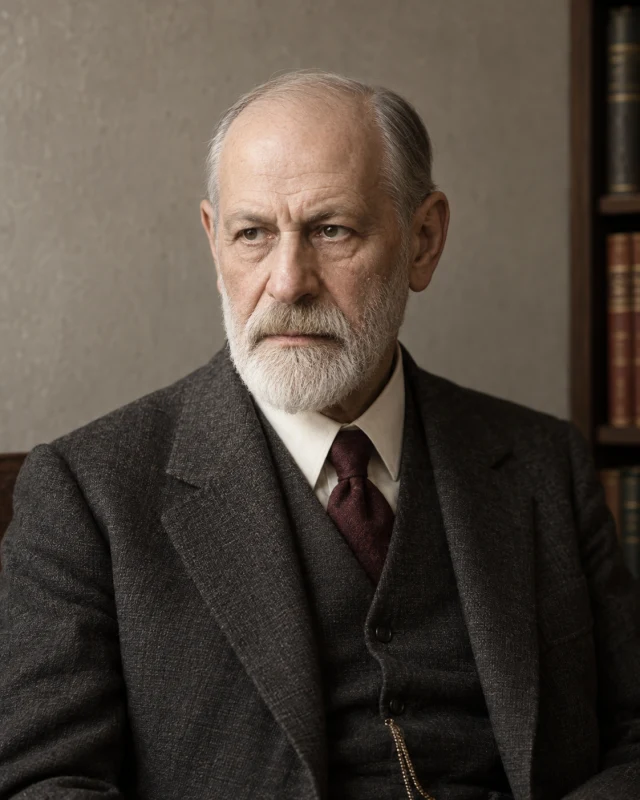
Sigmund Freud Reads "Dream Psychology" — In His Own Voice
Source recording: One recording, made in December 1938 in Freud's study at 20 Maresfield Gardens, London. Held by: BBC historical archive; copies at the Freud Museum London and the Freud Museum Vienna. Copyright: still under copyright or held under archive terms — see Voice Rights.
“The interpretation of dreams is the royal road to a knowledge of the unconscious activities of the mind.”
About this work
"Dream Psychology" (1920) is Freud's deliberately accessible distillation of his ideas on dreams — a doorway, in his publisher's words, for "the average alert reader" who would never wade through the legal-record density of The Interpretation of Dreams. In it Freud lays out his central claims plainly: that dreams are not nonsense but disguised wish-fulfilments, and that decoding them is the royal road into the unconscious.
To hear this introduction in Freud's own restored voice is to receive the founder's invitation to psychoanalysis directly from the founder — the ideas spoken in the accent and cadence of the man who first dreamed them up.
Who was Sigmund Freud?
Sigmund Freud (1856–1939) was the Viennese neurologist who founded psychoanalysis and, more than any single figure, gave the twentieth century its vocabulary for the inner life — the unconscious, repression, the slip of the tongue, the meaning hidden in a dream. Whether one accepts or contests his theories, the modern way of talking about the mind is largely his invention.
He spent nearly his whole career in Vienna, fleeing to London only in 1938 after the Nazi annexation of Austria. By then he was eighty-one and dying of jaw cancer; speaking had become an agony. It was in that London exile that the single surviving recording of his voice was made.
About the voice
This recording restores Freud's voice from his real archival material — chiefly the 1938 BBC broadcast made at his London home, the only known recording of his voice, in which the ailing, eighty-one-year-old Freud speaks in English about the origins of psychoanalysis. It is a careful reconstruction from that genuine source; it is not a narrator imitating him, and it is not a claim that Freud is speaking today.
Provenance: Restored from real recordings. We label every voice honestly — restored, narrated, or disputed.
Questions
What did Sigmund Freud sound like?
Frail and deliberate, with a soft Austrian-German accent shaping his careful English — captured in the recording he made for the BBC's archive in December 1938, when he was eighty-two and gravely ill, every word costing him effort.
Is this really his voice?
It is reconstructed from the December 1938 recording Freud made in his London study for the BBC's archive — the BBC asked him to record rather than broadcast, and it is one of the very few recordings of him that survive. Because so little of his voice survives, this is an honest restoration from limited real source material — not a living performance and not an impersonation.
Is "Dream Psychology" in the public domain?
Yes. The 1920 Eder translation is in the public domain in the United States.
More iconic voices
Discover more voices
Get free sample recommendations and news about new releases. Unsubscribe at any time.