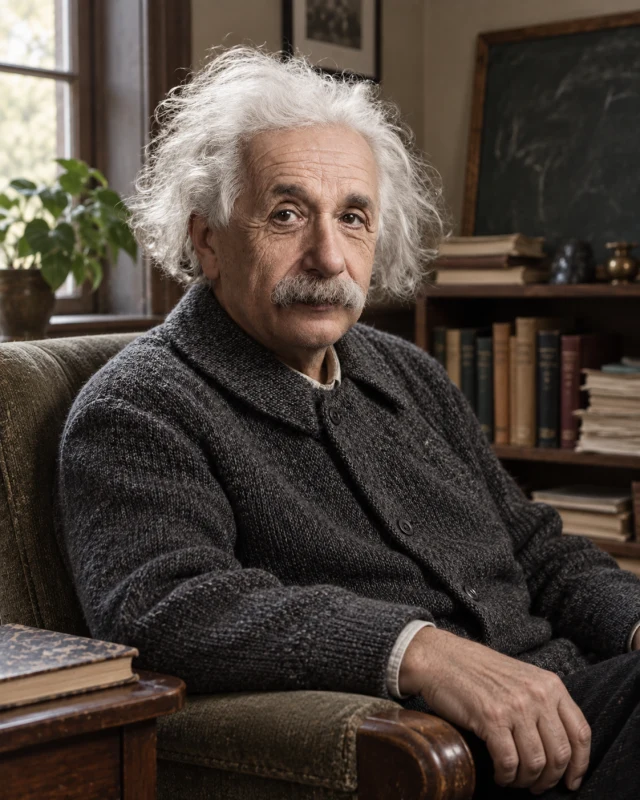
Albert Einstein Reads "Relativity" — In His Own Voice
Source recording: 22 Aug 1930, opening address at the 7th Deutsche Funkausstellung, Berlin - a 54-second excerpt, courtesy of the Deutsches Rundfunkarchiv. Held by: Deutsches Rundfunkarchiv, Frankfurt; Albert Einstein Archives, Hebrew University of Jerusalem (which runs a continuous licensing programme); American… Copyright: still under copyright or held under archive terms — see Voice Rights.
“I am interested in giving an exact insight into the theory of relativity to those who are not conversant with the mathematics of physics.”
About this work
Relativity: The Special and the General Theory (English translation by Robert W. Lawson, 1920; German original 1916) is Einstein's own attempt to explain his revolutionary ideas to ordinary readers — "those who, from a general scientific and philosophical point of view, are interested in the theory, but who are not conversant with the mathematical apparatus." It remains the most accessible doorway into relativity ever written, and the only one written by the man himself.
To hear it in Einstein's own restored voice is to sit, in effect, beside the source — the trains, the falling elevators, the bending light explained in the warm, accented cadence the world came to know from his radio broadcasts. The famous thought experiments arrive as he meant them: as a patient teacher thinking out loud.
Who was Albert Einstein?
Albert Einstein (1879–1955) reshaped humanity's picture of space, time, light, and gravity more profoundly than anyone since Newton. His 1905 "miracle year" gave the world special relativity and E=mc²; his 1915 general theory recast gravity as the curvature of spacetime itself. He won the 1921 Nobel Prize, fled Nazi Germany for Princeton, and became the twentieth century's defining symbol of genius and conscience alike.
Yet Einstein was also a gifted explainer and a warm, funny presence — heavily accented in English, quick to laugh, as ready to talk about Mozart and world peace as about physics. The voice behind the equations was unmistakably human.
About the voice
This recording is reconstructed from genuine archival recordings of Albert Einstein — including his 1930s and 1940s radio addresses and the spoken essays gathered in collections such as Albert Einstein in His Own Voice — which preserve over an hour of his actual speaking voice. It is a restoration built from real audio of Einstein, complete with his characteristic German accent, not a present-day impersonation, and it does not claim he is literally speaking today.
Provenance: Restored from real recordings. We label every voice honestly — restored, narrated, or disputed.
Questions
What did Albert Einstein sound like?
Einstein spoke English with a strong, gentle German accent, in a thoughtful, often playful cadence, frequently breaking into laughter. More than an hour of his actual recorded speech survives — radio broadcasts, spoken essays, and personal recordings — preserving exactly that voice.
Is this really his voice?
It is a restoration drawn from real archival recordings of Einstein's actual voice, so the accent and timbre are authentic to him. It is not a live recording of him reading this book and not an impersonation — it is his documented voice, reconstructed.
Is Relativity in the public domain?
Yes. Einstein's popular exposition first appeared in 1916, with the English translation in 1920, and is in the public domain in the United States, which is why it can be freely produced as an audiobook.
More iconic voices
Discover more voices
Get free sample recommendations and news about new releases. Unsubscribe at any time.