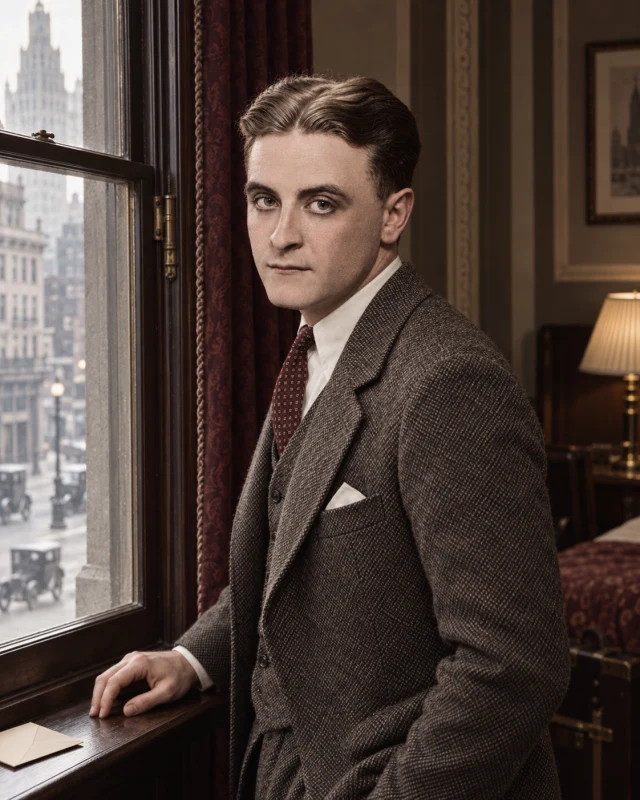
F. Scott Fitzgerald Reads "The Great Gatsby" — In His Own Restored Voice
Source recording: About 1940, California, probably a coin-operated self-recording booth: Keats's 'Ode to a Nightingale', Masefield's 'On Growing Old', and a speech from Othello. Three clips, none of them his own work. Held by: Irvin Department of Rare Books and Special Collections, University of South Carolina (Bruccoli Collection); Princeton University (Fitzgerald Papers) -… Copyright: still under copyright or held under archive terms — see Voice Rights.
“So we beat on, boats against the current, borne back ceaselessly into the past.”
About this work
The Great Gatsby (1925) is Fitzgerald's masterpiece and, for many, the great American novel. Through narrator Nick Carraway it tells of the mysterious Jay Gatsby, his enormous parties, and his doomed yearning for Daisy Buchanan and the green light across the bay — a story of love, money, reinvention, and the cruelty beneath the American Dream.
Heard in Fitzgerald's own restored voice, the famous closing cadences land differently. This is prose written to be heard, and the man who wept and labored over every sentence reading it returns the novel to something intimate and confessional — the Jazz Age narrated by the very voice that defined it.
Who was F. Scott Fitzgerald?
F. Scott Fitzgerald (1896–1940) was the chronicler and casualty of the Jazz Age — a term he himself coined. With his wife Zelda he became a glittering symbol of the 1920s, living lavishly between New York, Paris, and the Riviera while producing some of the most luminous American prose ever written.
His gift was a kind of romantic clear-sightedness: he adored wealth and glamour while seeing straight through to their hollowness. After the boom came the bust — financial ruin, Zelda's breakdowns, his own struggles with drink, and years of underpaid screenwriting in Hollywood, where he died of a heart attack at forty-four, believing himself a failure. Posterity disagreed.
About the voice
This recording reconstructs Fitzgerald's voice from his real surviving audio. In 1940, the last year of his life, Fitzgerald stepped into a make-your-own-record shop on Hollywood Boulevard and recorded himself reciting Othello's speech from Shakespeare and Keats's "Ode to a Nightingale" — rare discs that still survive. His restored voice is built from that genuine recording. It is an honest reconstruction of how he actually sounded, not a claim that he is speaking live today.
Provenance: Restored from real recordings. We label every voice honestly — restored, narrated, or disputed.
Questions
What did F. Scott Fitzgerald sound like?
Sonorous and theatrical, with a slightly formal, emotive delivery. His surviving 1940 recording shows a voice that reaches for grandeur even as it slurs and stumbles — earnest, literary, unmistakably of its era.
Is this really his voice?
It is a restoration drawn from his genuine 1940 home recording of Shakespeare and Keats. We are honest that this reconstructs how he actually sounded; it is not a live performance or an impersonation.
Is The Great Gatsby in the public domain?
Yes. The Great Gatsby entered the U.S. public domain on January 1, 2021, ninety-five years after its 1925 publication, and may now be freely read, recorded, and shared.
More iconic voices
Discover more voices
Get free sample recommendations and news about new releases. Unsubscribe at any time.