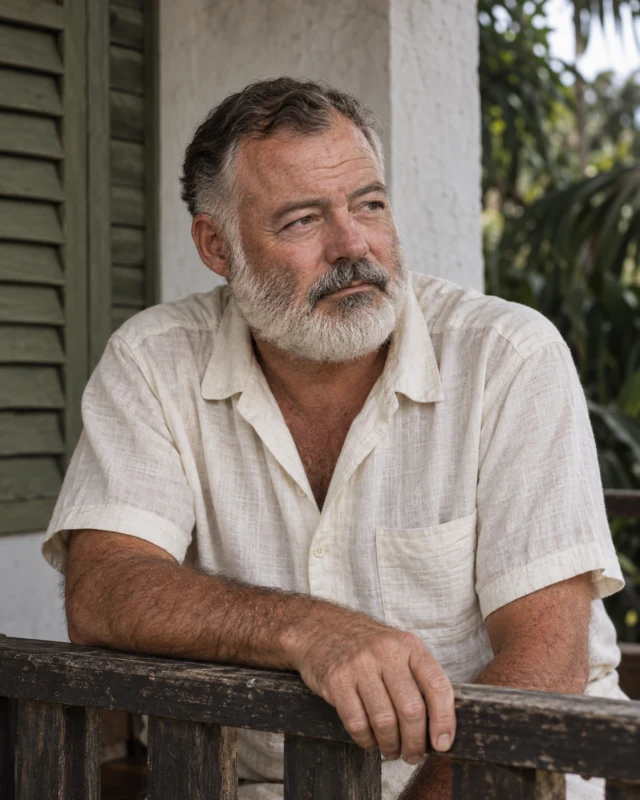
Ernest Hemingway Reads In Our Time — In His Own Restored Voice
Source recording: The 1954 Nobel acceptance speech, recorded in Cuba after the ceremony (Ambassador Cabot read it in Stockholm; the Internet Archive item says a Havana radio station made the recording). Caedmon TC 1185 was issued in 1965 from Finca Vigia tapes of about 1948-61. Held by: HarperCollins (Caedmon / Harper Audio masters); the Hemingway estate; John F. Kennedy Presidential Library, Ernest Hemingway Collection. Copyright: still under copyright or held under archive terms — see Voice Rights.
“All you have to do is write one true sentence. Write the truest sentence that you know.”
About this work
In Our Time (1925, Boni & Liveright) was Hemingway's first major collection and his American breakthrough. It interleaves fourteen short stories with terse prose vignettes of war and violence, building a fractured portrait of a generation marked by the Great War. The book introduces Nick Adams in stories like Indian Camp and the masterful Big Two-Hearted River, tracing a boyhood in Michigan against the unspoken trauma underneath.
F. Scott Fitzgerald called the Nick Adams stories "temperamentally new" in American fiction. Heard in Hemingway's own restored voice, the famous economy of these pages — the clipped dialogue, the things deliberately withheld — lands with extraordinary force; the flatness becomes a kind of pressure, every plain sentence carrying the weight of the iceberg beneath it.
Who was Ernest Hemingway?
Ernest Hemingway (1899–1961) was the American writer who stripped prose to the bone and changed how fiction sounds. A Red Cross ambulance driver wounded in the First World War, then a foreign correspondent and expatriate in 1920s Paris, he forged a style of short declarative sentences and submerged emotion — the "iceberg theory," where the weight of the story lies in what is left unsaid. He won the Pulitzer Prize and, in 1954, the Nobel Prize in Literature.
Hemingway was famously uneasy at the microphone, and very few recordings of his voice survive. That scarcity makes hearing him read all the more striking: a flat, plain American voice for the flattest, plainest, most loaded prose in modern literature.
About the voice
This recording restores Ernest Hemingway's voice from the genuine but sparse archival material that survives. Hemingway disliked microphones, and his voice is documented mainly through recordings such as his 1954 reading of his Nobel acceptance remarks (taped in Cuba) and informal fragments captured on a Webster wire recorder and a pocket Midgetape at his Havana home in the late 1950s. Those authenticated sources are the basis for reconstructing his delivery here. It is a faithful restoration applied to In Our Time, not a literal new performance; Hemingway died in 1961.
Provenance: Restored from real recordings. We label every voice honestly — restored, narrated, or disputed.
Questions
What did Ernest Hemingway sound like?
Hemingway spoke in a plain, slightly clipped American voice — measured and unshowy, with the same economy as his prose. He was uncomfortable being recorded, so the surviving fragments, like his 1954 Nobel remarks, capture a direct, understated delivery rather than a polished performer's.
Is this really his voice?
It is an honest restoration built from Hemingway's real but limited recordings — his 1954 Nobel reading and informal home tapes from the late 1950s — not a claim that he is performing today. He died in 1961; this reconstructs his documented voice and applies it to In Our Time.
Is In Our Time in the public domain?
Yes. In Our Time was first published in 1925 and is in the public domain in the United States, so this audiobook can be offered freely and legally.
More iconic voices
Discover more voices
Get free sample recommendations and news about new releases. Unsubscribe at any time.