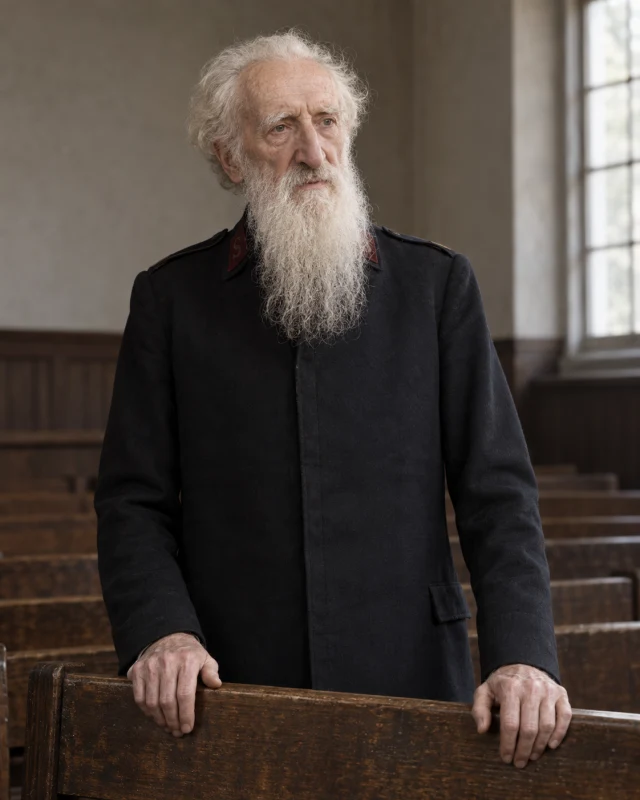
William Booth Reads In Darkest England — In His Own Restored Voice
Source recording: 'Please Sir, Save Me' (1906), listed as a British Library sound recording; 'Don't Forget' recorded by the Victor Talking Machine Company in 1910; 'Through Jordan' also survives. All are early commercial gramophone issues from his final years. Held by: MSU G. Copyright: appears to be in the US public domain — see Voice Rights.
“While women weep, as they do now, I'll fight; while little children go hungry, I'll fight.”
About this work
In Darkest England, and the Way Out (1890) was Booth's blueprint for rescuing 'the submerged tenth' — the millions trapped in poverty, drink, and homelessness. Borrowing the imagery of Stanley's expeditions into 'darkest Africa,' he argued that England's own poor lived in a darkness just as deep, and laid out a concrete scheme of city colonies, farm colonies, and overseas resettlement to lift them out.
A bestseller in its day, the book founded the Salvation Army's modern social-welfare work. To hear it in Booth's restored voice is to encounter the urgency of a man who preached it from the street corner — the same voice that survives on his early gramophone records.
Who was William Booth?
William Booth (1829–1912) was an English Methodist preacher who, with his wife Catherine, founded The Salvation Army and served as its first General. Raised in poverty in Nottingham and apprenticed to a pawnbroker, he came to believe that the gospel meant little to the starving until their material needs were met — a conviction that reshaped Victorian charity.
Taking his mission into the slums of East London, Booth built a worldwide movement organized along military lines, combining open-air preaching with soup kitchens, shelters, and work programs. By his death in 1912 he had become a national figure, mourned by 150,000 people, and one of the earliest public figures whose voice was preserved on sound recordings.
About the voice
This is a real restored voice. Booth made gramophone recordings late in his life — 'Please Sir, Save Me' (1906), 'Don't Forget' for Victor in 1910, and 'Through Jordan' — and those archival recordings survive. His voice here is reconstructed from that genuine source. It is a faithful restoration of how he actually sounded, not a claim that Booth is speaking live today, and the book itself was not recorded in his lifetime.
Provenance: Restored from real recordings. We label every voice honestly — restored, narrated, or disputed.
Questions
What did William Booth sound like?
Booth's actual voice survives on early gramophone recordings made in his final years — 'Please Sir, Save Me' (1906), 'Don't Forget' (Victor, 1910) and 'Through Jordan' — a fervent, plain-spoken, evangelistic delivery, worn but commanding, shaped by decades of open-air preaching.
Is this really William Booth's voice?
It is a voice restored from Booth's genuine surviving gramophone recordings, not an impersonation and not a literal live reading. In Darkest England was never recorded by him; the restored voice gives the manifesto sound.
Is In Darkest England in the public domain?
Yes. Published in 1890, In Darkest England, and the Way Out is in the public domain worldwide and may be read, shared, and adapted freely.
More iconic voices
Discover more voices
Get free sample recommendations and news about new releases. Unsubscribe at any time.