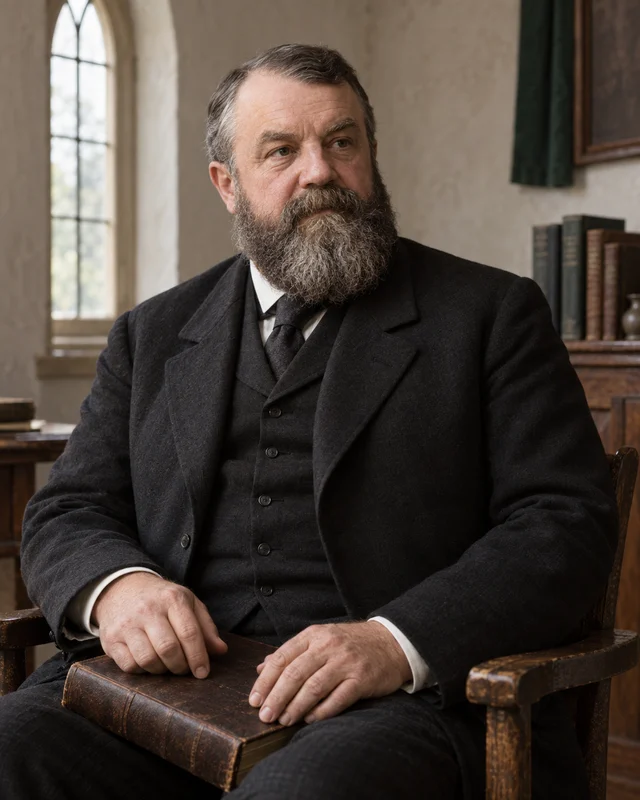
Dwight L. Moody Reads Prevailing Prayer — In His Own Restored Voice
Source recording: January 1898 - discs for the Gramophone label; two recordings are reported, 'The 91st Psalm' and the Beatitudes/'The Sermon on the Mount'. Archeophone's project blog describes the Moody item as a release. Held by: Moody Bible Institute archives host the audio; Archeophone Records produced the 2016 restoration; the surviving copy came from the collector David Gio… Copyright: appears to be in the US public domain — see Voice Rights.
“Every great movement of God can be traced to a kneeling figure.”
About this work
Prevailing Prayer: What Hinders It? (1884) is Moody's classic on the practice of prayer. Packed with the plain illustrations and homely stories that made him a household name, it walks through the elements of effective, persevering prayer — and, true to its title, the things that quietly drain prayer of its power. It is direct, unsentimental, and meant for daily use.
To hear it in Moody's own restored voice is uniquely moving, because almost nothing of his voice survives. The blunt Yankee earnestness that filled vast halls is reconstructed from the few precious seconds we still have — and the book reads exactly as he intended it: a man talking to you, urging you to your knees.
Who was Dwight L. Moody?
Dwight Lyman Moody (1837–1899) was the most celebrated American evangelist of the nineteenth century — a Boston shoe clerk turned Chicago preacher who, with his song-leader Ira Sankey, drew crowds of thousands across the United States and Britain. Plainspoken, untrained in theology, and relentlessly practical, he reached ordinary people in a way the learned pulpits could not.
His legacy outlived him in brick and institution: the Moody Church, the Northfield and Mount Hermon schools, and the Moody Bible Institute, which still trains workers today. He preached a simple, urgent gospel of grace, and he believed above all in prayer as the engine behind every revival he ever saw.
About the voice
This recording restores Dwight L. Moody's voice from the only known surviving archival audio of him — two phonograph recordings made in 1898, the year before his death, in which he reads the Beatitudes and from Psalm 91. These rare cylinders, preserved through the Moody Bible Institute, are used to reconstruct his vocal character so this book can be heard in his own manner of speaking. This is a faithful restoration from a very small surviving sample, not a claim that he is literally speaking today.
Provenance: Restored from real recordings. We label every voice honestly — restored, narrated, or disputed.
Questions
What did D. L. Moody sound like?
The two surviving 1898 recordings preserve a forceful, plainspoken American voice with a blunt New England earnestness — the booming, unpolished delivery of a man who filled enormous halls without a microphone and meant every word.
Is this really his voice?
It is a restoration drawn from the only known recordings of Moody — two cylinders from 1898 in which he reads Scripture. Because so little survives, his vocal character is reconstructed from that small genuine sample. It is an honest restoration of how he sounded, not a recording of him made today.
Is Prevailing Prayer in the public domain?
Yes. Published in 1884, Prevailing Prayer is long in the public domain in the United States, which is why we can offer it narrated in his restored voice.
More iconic voices
Discover more voices
Get free sample recommendations and news about new releases. Unsubscribe at any time.