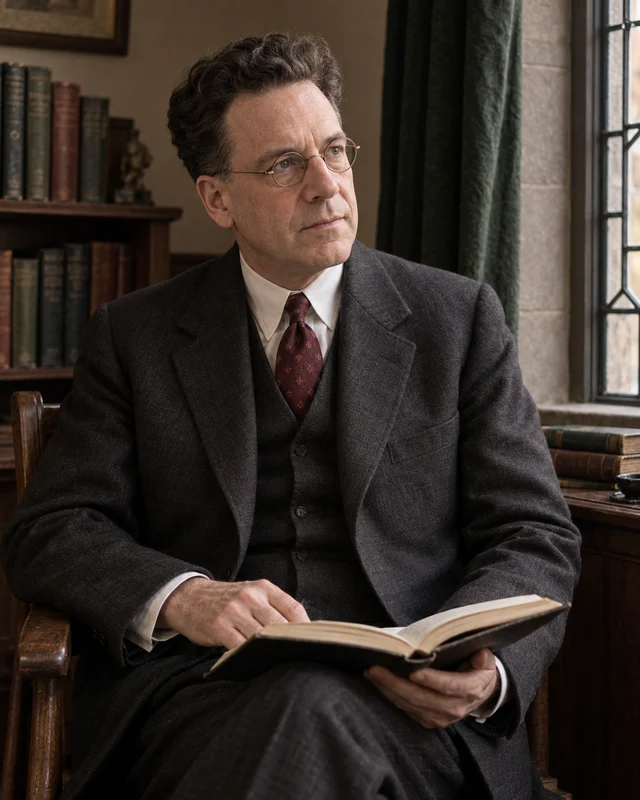
Harry Emerson Fosdick Reads "Christianity and Progress" — In His Own Voice
Source recording: Victor matrices BVE-67536 'A litany of praise' and BVE-67537 'A litany of the nation', recorded 2 Jun 1931 with the Riverside Church Choir; plus NBC National Vespers 1927-46 and WRVR pre-recorded talks from 1961 on. Held by: Sony (RCA Victor successor); NBCUniversal; Riverside Church / American Archive of Public Broadcasting. Copyright: still under copyright or held under archive terms — see Voice Rights.
“Religion has been man's most persistent effort to reach out toward the highest he could conceive.”
About this work
"Christianity and Progress" (1922) gathers the Cole Lectures Fosdick delivered at Vanderbilt Divinity School. Across them he confronts the wreckage and disillusion that followed the First World War and asks whether the modern idea of progress can survive — and what Christianity owes to it. He argues that genuine progress is moral and spiritual, not merely mechanical, and that faith is the engine, not the enemy, of human advance.
To hear these lectures in the cadence of the man who delivered them from the pulpit is to recover the rhythm of the spoken sermon they were written to be — the pauses, the build, the pastoral warmth that made his Sunday broadcasts unmissable.
Who was Harry Emerson Fosdick?
Harry Emerson Fosdick (1878–1969) was the most influential American liberal Protestant preacher of the early twentieth century. A Baptist who served First Presbyterian Church in Manhattan and later the great inter-denominational Riverside Church, he became the lightning rod of the fundamentalist–modernist controversy with his 1922 sermon "Shall the Fundamentalists Win?" His message was that faith must grow with knowledge rather than retreat from it.
Fosdick was also a pioneer of the airwaves. From the late 1920s through 1946 he preached on NBC's National Vespers Hour, carried by shortwave to seventeen countries, his measured, resonant voice reaching millions of American living rooms every Sunday. Few preachers of his generation are so well preserved in sound.
About the voice
This recording restores Fosdick's voice from his real archival material — the broadcast sermons and addresses he delivered over NBC radio and other surviving recordings made during his lifetime. It is a reconstruction built from genuine recordings of the man himself; it is not a living person speaking today, and it is not a generic narrator standing in for him.
Provenance: Restored from real recordings. We label every voice honestly — restored, narrated, or disputed.
Questions
What did Harry Emerson Fosdick sound like?
Warm, deliberate, and richly resonant — the polished pulpit voice of a man who preached weekly to a national radio audience for nearly two decades. His delivery favored long, building sentences and pastoral calm over fire-and-brimstone urgency.
Is this really his voice?
It is reconstructed from Fosdick's genuine archival recordings — his radio sermons and addresses survive in substantial quantity. We restore that real voice to read this text; we never claim he is literally speaking today.
Is "Christianity and Progress" in the public domain?
Yes. Published in 1922, the work is in the public domain in the United States.
More iconic voices
Discover more voices
Get free sample recommendations and news about new releases. Unsubscribe at any time.