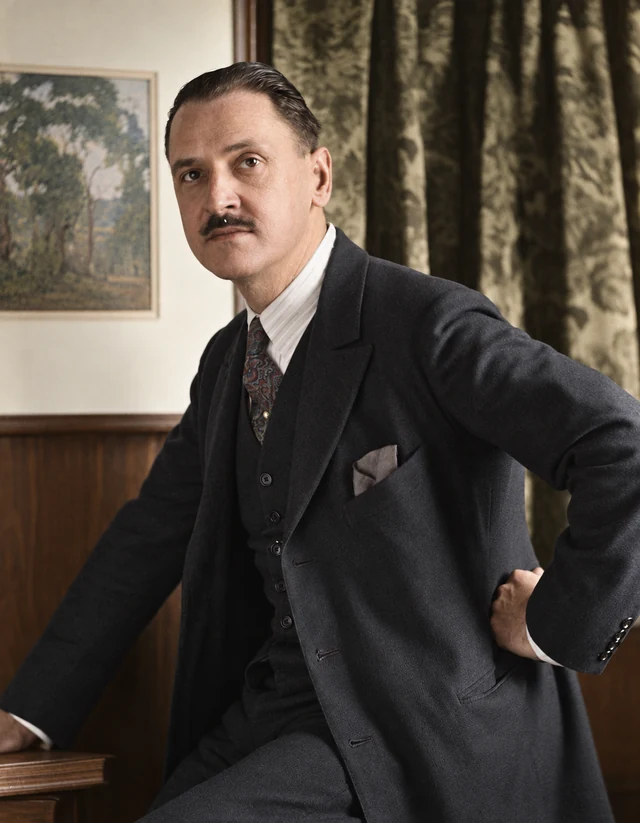
W. Somerset Maugham Reads Of Human Bondage — In His Own Restored Voice
Source recording: On-screen spoken introductions to the anthology films made from his stories: Quartet (1948 - 'The author appears at the start and end of the movie to introduce the stories and comment about his writing career'), Trio (1950) and Encore (1951). Held by: Rank/Gainsborough successors for the British films; the US television material would sit with the network/producer successors. Copyright: still under copyright or held under archive terms — see Voice Rights.
“This is a novel, not an autobiography; though much in it is autobiographical, more is pure invention.”
About this work
Of Human Bondage (1915) is Maugham's acknowledged masterpiece: the long, intimate story of Philip Carey, a sensitive boy born with a clubfoot, orphaned and raised by a pious aunt and uncle, who fumbles his way through faith, art, medicine and a ruinous infatuation toward a hard-won peace with his own limitations. It is a bildungsroman — a novel of education — and one Maugham admitted was steeped in his own youth, even as he insisted that more of it was invention than memory.
To hear it in Maugham's own restored voice changes the experience. The detachment readers sometimes mistake for coldness reveals itself, in his measured delivery, as the hard-won calm of a man who learned to live with what he could not change. Philip's struggle and Maugham's voice carry the same quiet undertow.
Who was W. Somerset Maugham?
William Somerset Maugham (1874–1965) was one of the most widely read and highest-paid English authors of his era, a novelist, short-story master and playwright whose unsentimental eye and clean, conversational prose made him a fixture of the early twentieth century. Orphaned young and raised by a clergyman uncle, he qualified as a doctor before abandoning medicine for the page — and carried a lifelong stammer that shadowed his speech much as a clubfoot shadows his most famous hero.
Maugham's gift was for looking at human weakness without flinching and without cruelty. From Of Human Bondage to The Moon and Sixpence and The Razor's Edge, he wrote about obsession, ambition and the slow business of becoming oneself, in sentences so plain they can sound like a man simply telling you the truth across a table.
About the voice
This narration is reconstructed from genuine archival recordings of W. Somerset Maugham — including the on-screen introductions he filmed for Quartet (1948), Trio (1950) and Encore (1951) — to restore the timbre, accent and cadence of his real speaking voice. It is a faithful restoration of how Maugham actually sounded, not a claim that the author is speaking live today; the words you hear are his text, voiced in his recovered tone.
Provenance: Restored from real recordings. We label every voice honestly — restored, narrated, or disputed.
Questions
What did W. Somerset Maugham sound like?
Maugham spoke in a precise, clipped, upper-register English voice marked by a lifelong stammer he worked hard to control, which gave his speech a careful, deliberate rhythm. The spoken introductions he filmed for the anthology films made from his stories preserve that dry, understated delivery — the same restraint readers feel in his prose.
Is this really Maugham's voice?
It is a restoration built from his real archival recordings, not a live performance. We reconstruct the qualities of his documented speaking voice and use them to narrate the public-domain text, so you hear his words in his own restored timbre and cadence rather than a generic narrator's.
Is Of Human Bondage in the public domain?
Yes. Of Human Bondage was first published in 1915 and is in the public domain in the United States and Canada, which is why it can be freely produced as an audiobook like this one.
More iconic voices
Discover more voices
Get free sample recommendations and news about new releases. Unsubscribe at any time.