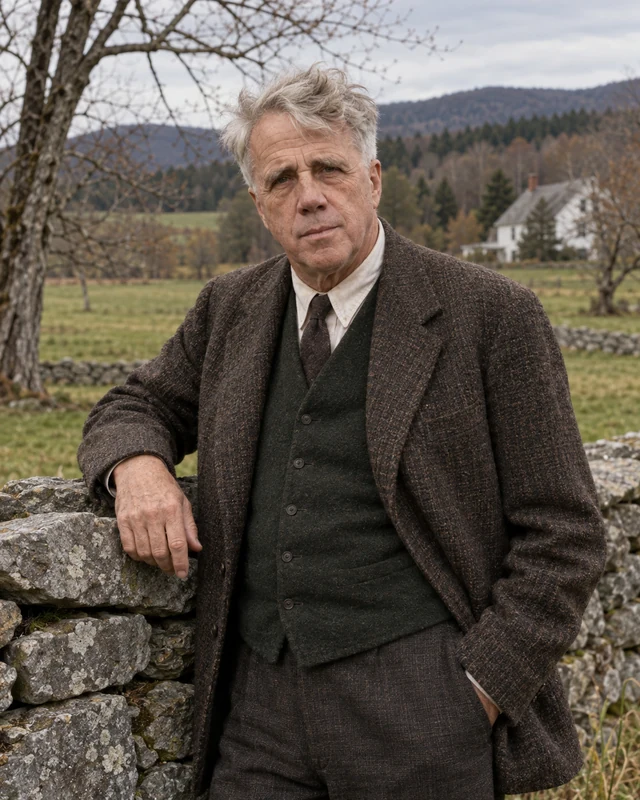
Robert Frost Reads North of Boston — In His Own Voice
Source recording: 5 May 1933, Columbia University Speech Lab (Hibbitt and Greet), twelve poems; a second session 24 Oct 1934. Rediscovered by Mustazza in 2014 and released 2015-16. Held by: Columbia University Rare Book and Manuscript Library (originals); Estate of Robert Frost and Henry Holt and Company (copyright notice on the release)… Copyright: still under copyright or held under archive terms — see Voice Rights.
“Good fences make good neighbors.”
About this work
North of Boston (1914) is the book that made Frost. Seventeen poems, most of them written as small dramas and dialogues between New England farmers, it gave the world "Mending Wall," "The Death of the Hired Man," "Home Burial," and "After Apple-Picking." Frost called it "a book of people" — grief over a dead child, a hired man come home to die, neighbors arguing across a wall — told in the unhurried talk of people who don't waste words.
Hearing these poems in Frost's own restored voice changes them. "Home Burial" stops being a page of dialogue and becomes a marriage cracking apart in real time; "Mending Wall" turns wry and unsettling. The dramatic monologues were written for the ear — this is the closest you can get to Frost reading them at his own kitchen table.
Who was Robert Frost?
Robert Frost (1874–1963) is the rare poet whose work became part of the American weather. Born in San Francisco and shaped by the farms and stone walls of New Hampshire and Vermont, he wrote in the plain cadence of rural New England speech while smuggling in some of the darkest questions in modern verse. He won four Pulitzer Prizes and, in 1961, read at John F. Kennedy's inauguration, the first poet ever to do so.
What makes Frost worth hearing rather than only reading is his voice itself — slow, dry, granite-flat, a Yankee drawl that lets a casual line like "Good fences make good neighbors" land with quiet menace. He believed a poem carried its meaning in its "sound of sense," the music underneath the words, and no one performed that better than the man who wrote it.
About the voice
This recording uses a voice digitally reconstructed from Robert Frost's real archival recordings — Frost read widely for the Library of Congress, the Poetry Center, and university speech labs from the 1930s through the 1950s, leaving a rich record of his actual speaking voice. Those genuine recordings are the source material for the restored narration here. This is not a live performance and not Frost speaking today; it is a faithful reconstruction of his documented voice applied to the full text of North of Boston.
Provenance: Restored from real recordings. We label every voice honestly — restored, narrated, or disputed.
Questions
What did Robert Frost sound like?
Slow, dry, and unhurried, with a flat New England drawl and a habit of letting lines drop into silence. He read deliberately and conversationally, almost reluctant to perform, which gave even his darkest poems a deceptive plainness. Many listeners are surprised how granite-hard and wry he sounds compared with how his poems read on the page.
Is this really Robert Frost's voice?
It is a voice reconstructed from Frost's real archival recordings, not a new performance by him. Frost left many genuine recordings of himself reading, made between the 1930s and 1950s, and those are the basis for this restored narration. We don't claim he is speaking today — this is a faithful reconstruction of his documented voice.
Is North of Boston in the public domain?
Yes. North of Boston was first published in 1914 and is in the public domain in the United States, so the full text is free to read, share, and adapt — including in audio form like this edition.
More iconic voices
Discover more voices
Get free sample recommendations and news about new releases. Unsubscribe at any time.