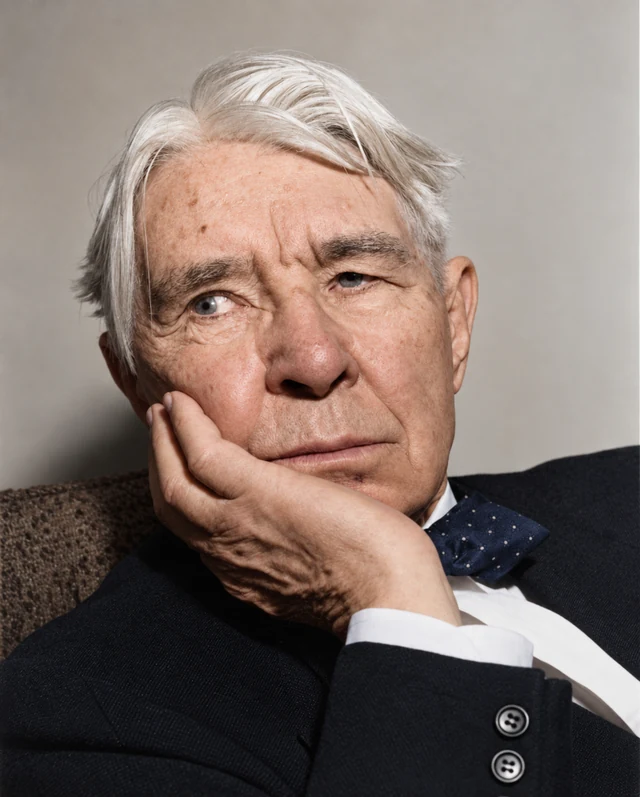
Carl Sandburg Reads Rootabaga Stories — In His Own Restored Voice
Source recording: Victor trials 9 Dec 1925 (unissued); first published session 4 Mar 1926, Camden NJ, matrices BVE-34945 to BVE-34950, issued as Victor 20135 with an issue date of 10/1926. His earliest SPEECH recordings are the Decca 'The People, Yes' sides of 17 Jan 1941. Held by: Sony Music Entertainment (Victor/Columbia masters); Universal (Decca); the Sandburg estate; NPS Carl Sandburg Home NHS; Library of Congress. Copyright: still under copyright or held under archive terms — see Voice Rights.
“"They have terribly mixed-up dreams, the people of the Village of Liver-and-Onions."”
About this work
Rootabaga Stories (1922) is Sandburg's set of interlinked American fairy tales, invented for his own daughters. Restless with the kings and castles of European folklore, he built a homegrown dreamland — the Rootabaga Country, the Village of Liver-and-Onions, characters like the Potato Face Blind Man — out of nonsense words, prairie rhythms, and gentle melancholy.
Because the stories were born as bedtime tellings, they live or die on voice: the made-up names, the repetitions, the sing-song lilt all want to be heard. Hearing them in Sandburg's own restored voice is the closest thing to sitting where his daughters sat — the tales delivered in the slow, warm Midwestern cadence that created them.
Who was Carl Sandburg?
Carl Sandburg (1878–1967) was the son of Swedish immigrants in Galesburg, Illinois, who left school early, rode the rails as a young hobo, and worked a string of laboring jobs before becoming one of America's defining poets. He celebrated working people and the modern city in free verse — most famously calling Chicago the "City of the Big Shoulders" — and won three Pulitzer Prizes, two for poetry and one for his monumental biography of Abraham Lincoln.
He was also a folk-song collector and performer who toured with a guitar, and that musician's ear shaped how he wrote and read. Few American authors of his stature were as committed to the spoken, sung, and recited word.
About the voice
This recording restores Carl Sandburg's voice from genuine archival audio of the author himself, who recorded readings of the Rootabaga Stories on LP during his lifetime. From those authenticated recordings his unmistakable slow, deep, prairie-inflected delivery is reconstructed to narrate the collection. It is a faithful restoration built on real evidence of how Sandburg sounded reading these very stories — not a live performance, and not a claim that he is speaking today.
Provenance: Restored from real recordings. We label every voice honestly — restored, narrated, or disputed.
Questions
What did Carl Sandburg sound like?
Sandburg read in a famously slow, deep, gently musical voice with a soft Midwestern lilt — the cadence of a folk singer turned storyteller. He recorded the Rootabaga Stories himself, and this restoration draws directly on that delivery.
Is this really Sandburg's voice?
Yes, restored from authenticated recordings Sandburg actually made of these stories. It is an honest reconstruction used to narrate the book — not a live recording, and we never claim it is Sandburg speaking today.
Is Rootabaga Stories in the public domain?
Yes. Published in 1922, Rootabaga Stories is in the public domain in the United States, so the text can be freely narrated and shared.
More iconic voices
Discover more voices
Get free sample recommendations and news about new releases. Unsubscribe at any time.