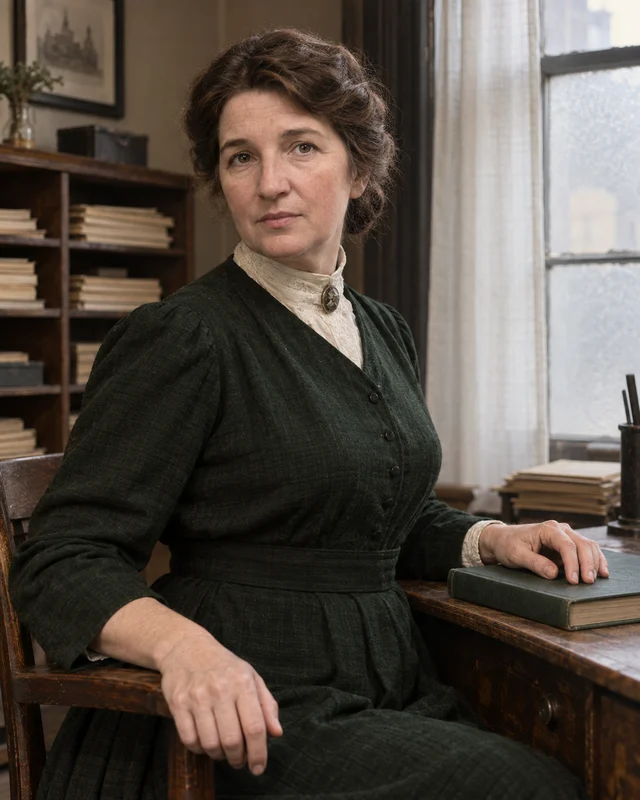
Margaret Sanger Reads "Woman and the New Race" — In Her Own Voice
Source recording: The Mike Wallace Interview, ABC, 21 September 1957 - a 16mm kinescope of 29 min 32 s, item HRC_WAL0059. Held by: Harry Ransom Center, University of Texas at Austin, which states: 'Copyright of all of the interviews is held by Mike Wallace... Copyright: still under copyright or held under archive terms — see Voice Rights.
“No woman can call herself free who does not own and control her body.”
About this work
Woman and the New Race (Brentano's, 1920) was Sanger's first book and her most influential — a passionate argument that a woman's control over her own body is the foundation of every other freedom. With an introduction by the sexologist Havelock Ellis, it frames birth control as the lever that could lift women out of forced motherhood and reshape society itself.
It opens with one of the most quoted lines in early feminist literature: "No woman can call herself free who does not own and control her body." Heard in Sanger's own restored voice, the book stops being a museum text and becomes what it was — a person speaking, urgently, to the women of her time.
Who was Margaret Sanger?
Margaret Sanger (1879–1966) was the American nurse, writer, and activist who coined the term birth control and spent her life forcing it into public conversation. Working among immigrant women on New York's Lower East Side, she watched poverty and unwanted pregnancy destroy lives, and turned that anger into a movement — opening the country's first birth-control clinic in 1916, founding the organization that would become Planned Parenthood, and going to jail for her convictions.
Sanger remains a genuinely contested figure: a fierce champion of women's autonomy whose later embrace of eugenic arguments is widely and rightly criticized today. Listening to her own words, in her own voice, is a way to meet that complicated history directly rather than at second hand.
About the voice
This recording is reconstructed from genuine archival recordings of Margaret Sanger — including her 1953 broadcast on Edward R. Murrow's This I Believe and the "Portrait in Speech" recording held at Smith College — that preserve her actual speaking voice. It is a restoration built from real audio of Sanger, not a present-day impersonation, and it does not claim that she is literally speaking today.
Provenance: Restored from real recordings. We label every voice honestly — restored, narrated, or disputed.
Questions
What did Margaret Sanger sound like?
Sanger spoke in a measured, deliberate American voice with the cadence of a practiced public speaker and reformer. Surviving recordings — including her This I Believe radio broadcast and an oral self-portrait at Smith College — preserve her actual voice.
Is this really her voice?
It is a restoration drawn from real archival recordings of Sanger's actual voice, so the sound is rooted in authentic audio of the woman herself. It is not a live recording of her reading this book and not an impersonation — it is her documented voice, reconstructed.
Is Woman and the New Race in the public domain?
Yes. Published in 1920, the book is in the public domain in the United States, which is why it can be freely produced as an audiobook.
More iconic voices
Discover more voices
Get free sample recommendations and news about new releases. Unsubscribe at any time.