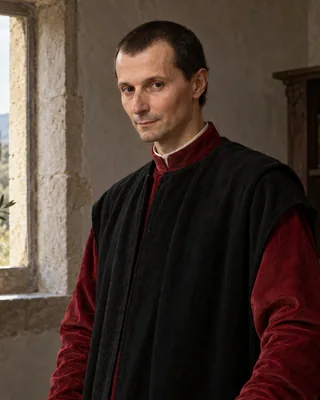
The Prince — narrated by a designed AI voice
Press play — the AI narration lights up word by word. This sample is free.
Read the transcript
Upon this a question arises: whether it be better to be loved than feared or feared than loved? It may be answered that one should wish to be both, but, because it is difficult to unite them in one person, it is much safer to be feared than loved, when, of the two, either must be dispensed with. Because this is to be asserted in general of men, that they are ungrateful, fickle, false, cowardly, covetous, and as long as you succeed they are yours entirely; they will offer you their blood, property, life, and children, as is said above, when the need is far distant; but when it approaches they turn against you. And that prince who, relying entirely on their promises, has neglected other precautions, is ruined; because friendships that are obtained by payments, and not by greatness or nobility of mind, may indeed be earned, but they are not secured, and in time of need cannot be relied upon; and men have less scruple in offending one who is beloved than one who is feared, for love is preserved by the link of obligation which, owing to the baseness of men, is broken at every opportunity for their advantage; but fear preserves you by a dread of punishment which never fails.
“It is much safer to be feared than loved, when, of the two, either must be dispensed with.”
About this work
The Prince was written in 1513 and dedicated to Lorenzo de' Medici, but printed only in 1532, five years after Machiavelli's death. In twenty-six short chapters it sorts principalities by how they are acquired, studies rulers from Cesare Borgia to the popes, and asks whether a prince should be loved or feared. This is W. K. Marriott's 1908 English translation.
Heard aloud, its short chapters sound like what they were meant to be: advice from an experienced official to a ruler.
Who was Niccolò Machiavelli?
Niccolò Machiavelli (1469–1527) served the Florentine republic for fourteen years as secretary of its Second Chancery, traveling on missions to the king of France, the papal court and Cesare Borgia. When the Medici returned to power in 1512 he lost his post; the next year he was imprisoned and tortured on suspicion of conspiracy, and he retired to his farm near San Casciano.
There he wrote The Prince, the Discourses on Livy, The Art of War, the comedy The Mandrake and the Florentine Histories. His clear-eyed account of how power is won and kept gave the language a word, "Machiavellian," that still follows him.
About the voice
This edition uses a designed AI voice: a new voice generated from a written description of Niccolò Machiavelli’s voice, not cloned from any recording of the author. It is not a recording of Niccolò Machiavelli reading this work.
Provenance: Designed AI voice — designed from a written description, not cloned from any recording of the author. We label every voice by how it was made for this edition — restored, designed, studio AI, or disputed.
Questions
Is this Niccolò Machiavelli’s recorded voice?
No. This edition uses a designed AI voice: a new voice generated from a written description of Niccolò Machiavelli’s voice, not cloned from any recording of the author. It is not a recording of Niccolò Machiavelli reading this work.
Is The Prince in the public domain?
Yes. Machiavelli wrote it in 1513, and W. K. Marriott's English translation was published in 1908; it is in the public domain in the United States; availability varies by country.
More AI voices
Discover more voices
Get free sample recommendations and news about new releases. Unsubscribe at any time.