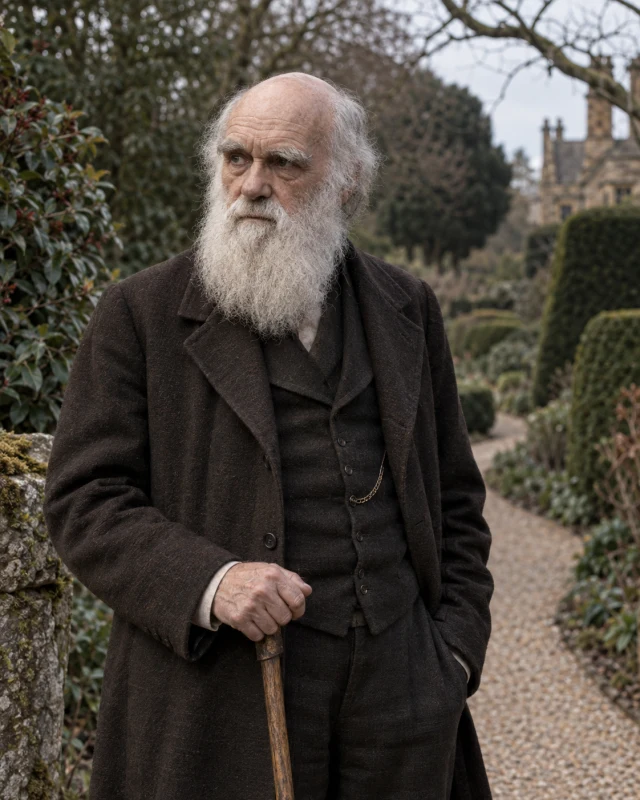
The Voyage of the Beagle — Studio AI narration
“Nothing can be more improving to a young naturalist, than a journey in distant countries.”
About this work
The Voyage of the Beagle (1839), first published as Journal and Remarks, is Darwin's record of the second survey expedition of HMS Beagle — Patagonian plains, Andean earthquakes, Brazilian rainforest, and the Galápagos finches and tortoises that would haunt his later thinking. It is part travelogue, part field notebook, and one of the most charming science books ever written, prized for its wonder as much as its observation.
Heard aloud, it becomes what it always was at heart: a young man's running journal, read by lamplight after a hard day ashore. The narration lets Darwin's curiosity, awe and dawning unease about the natural world unfold the way he first set them down — discovery by discovery, before he knew where any of it would lead.
Who was Charles Darwin?
Charles Darwin (1809–1882) was the English naturalist whose theory of evolution by natural selection reshaped how humanity understands life on Earth. Before On the Origin of Species made him famous and controversial, he was a curious, unproven young man who talked his way aboard a survey ship and spent nearly five years collecting, observing and writing his way around the globe.
That voyage, he later said, was "by far the most important event in my life, and has determined my whole career." The patient, almost boyish attentiveness that fills his Beagle journal is the same quality that would, decades later, let him assemble one of the most consequential ideas in the history of science.
About the voice
This edition uses a studio AI voice, not a restoration of Charles Darwin's recording. It is a new AI performance, not a recording of the author reading this work.
Provenance: Studio AI voice. We label every voice by the source used for this edition — restored, studio AI, or disputed.
Questions
Is this Charles Darwin’s recorded voice?
This edition uses a studio AI voice, not a restoration of Charles Darwin's recording. It is a new AI performance, not a recording of the author reading this work.
Is this Charles Darwin’s recorded voice?
This edition uses a studio AI voice, not a restoration of Charles Darwin's recording. It is a new AI performance, not a recording of the author reading this work.
Is The Voyage of the Beagle in the public domain?
Yes. First published in 1839, The Voyage of the Beagle has long been in the public domain worldwide, including the United States and Canada, so it can be freely produced as an audiobook.
More iconic voices
Discover more voices
Get free sample recommendations and news about new releases. Unsubscribe at any time.